Marion Epoxy Flooring has spent more than 20 years on epoxy flooring, and in Amana the floor we are most often asked to think through is one that lives under a finishing process: a workroom where stain, sealer or lacquer goes on and the floor catches whatever misses the workpiece. That kind of floor is judged less by its color than by how it cleans, how it takes scraping and what sits underneath it.
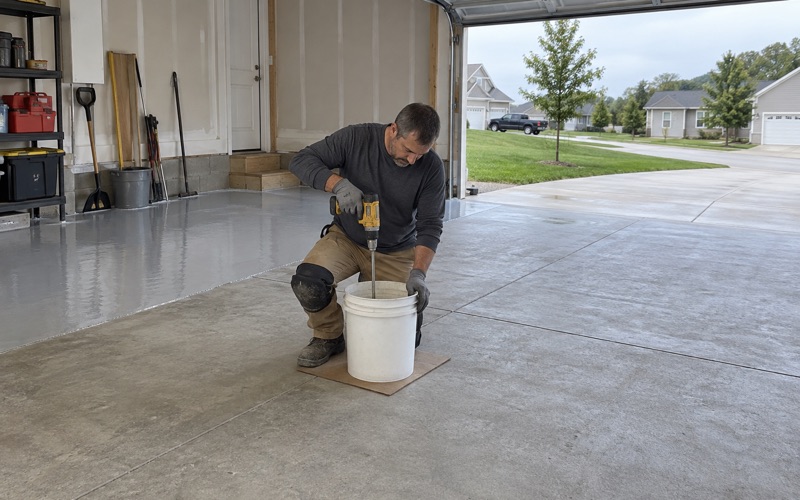
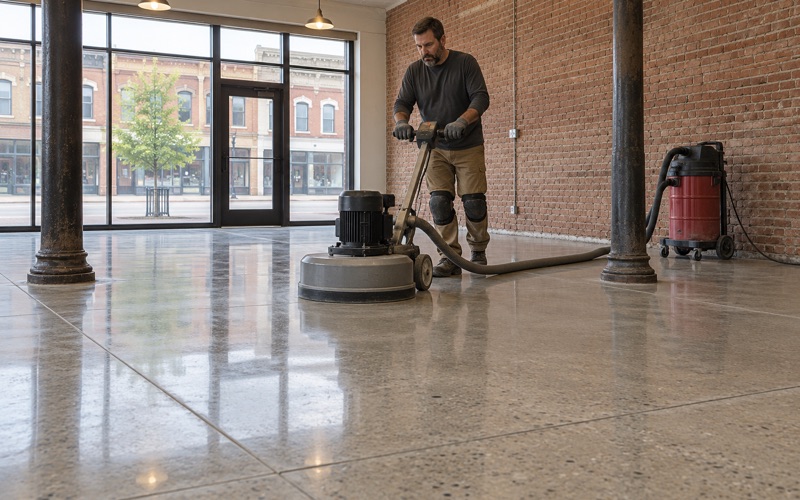
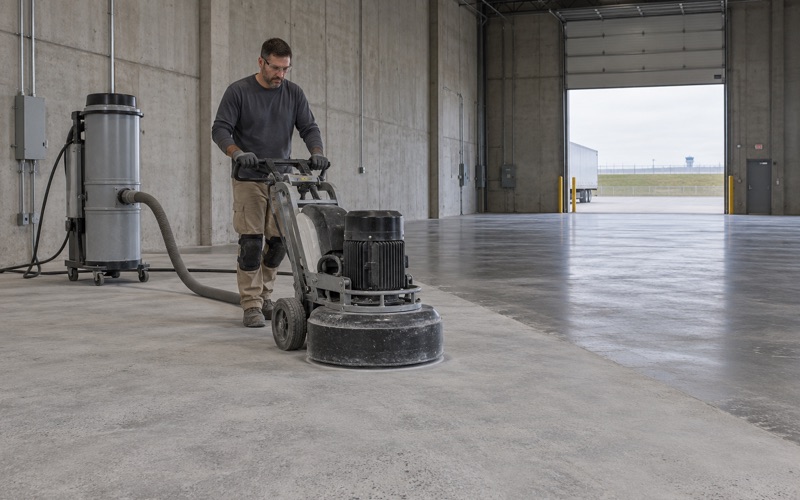
Every job we take starts with the slab itself. We open the concrete with a diamond grinder or a shot blaster rather than an acid etch, which leaves a measurable surface profile for the coating to grip. A moisture test goes into the written scope before we give a final price, and the proposal spells out the product line, the coat count and the finished thickness, so the installed floor can be checked against the paper.
We are just as plain about what a coating cannot do. It is not a fire rating, it is not waterproofing and it is not radon work. The sections below explain where those lines fall on a shop floor in a village like this one.
A Working Furniture Shop in Main Amana’s Old Calico Mill
Main Amana is one of the seven Amana Colonies villages, settled by German Radical Pietists who called themselves the True Inspiration Congregations and moved to Iowa in 1856. They lived a communal life until 1932. Much of what they built still stands, and some of it still earns its keep as a workplace.
The Amana Furniture & Clock Shop
The National Park Service notes that the Amana Furniture Shop occupies the former Calico Mill, which once produced printed cloth for the national market. Sometime after the 1932 Great Change, cabinet and furniture making that each village had once handled on its own was consolidated in that building. Today the Amana Furniture & Clock Shop at 724 48th Ave. builds solid walnut, oak and cherry furniture and clocks.
The shop’s own descriptions mention matching wood grains, testing durability and expert finishing, along with a workshop gallery where visitors watch craftsmen at work. We have no connection to the shop and have never worked on its floors. We name it because it is the clearest example of fine wood finishing still done in Amana itself, and because finishing is where a floor stops being a background detail.
Old Buildings, Uncertain Floors
Amana is a village of old buildings. Census estimates put 155 of Main Amana’s 312 housing units in the 1939-or-earlier bracket and none built since 2010, though the sample is small. The Park Service dates the start of construction on the Amana Woolen Mill, also on 48th Avenue, to 1859.
In buildings of that age a workroom floor can be original plank, a later concrete slab, or concrete poured over something older and patched more than once. We do not assume which one a room has. We look, map every crack, spall and old coating, and tell the owner when a slab needs repair or replacement before anything should go on it.
Looking for epoxy-flooring closer to Tiffin? See Epoxy-Flooring Services in Tiffin.
Where Finish Is Sprayed, the Floor Is Part of the Rule
Wiped oil and brushed finishes are one kind of work. Spraying finish made with flammable or combustible materials is another, and it brings in a specific federal standard, 29 CFR 1910.107, which Iowa OSHA applies through its state plan. We do not know whether any particular Amana shop sprays its finishes, and the published descriptions of the furniture shop do not say. The rule applies wherever spraying of that kind actually happens.
What Counts as a Spraying Area
The standard defines a spraying area as any area in which dangerous quantities of flammable vapors or mists, or combustible residues, dusts or deposits, are present because of the spraying process. That definition turns on what is in the air and on the surfaces, not on whether a room is labeled a booth.
Overspray that settles on the floor around a sawhorse, a turntable or a drying rack is exactly the kind of deposit it describes. The floor is not a bystander in that room. It collects the residue the rule is written about, and it is where a worker stands while the finish goes on.
Why the Floor Question Comes Before the Coating
Most customers call us about a coating. In a finishing room, the earlier question is what the floor is made of, because the standard treats a combustible floor differently from one that is not. That answer decides what work is even on the table, so we ask to see the finishing area before we talk about systems, colors or price.
Amana is an unincorporated village with no city government; Iowa County is the general-purpose government, and workplace safety falls to Iowa OSHA. None of those offices approves a floor coating or a contractor. Nothing we install is OSHA-approved, because OSHA approves no floor product or installer, and we will not describe a floor that way.
Combustible Floors and the Noncombustible Covering
Section (b)(3) of the standard is short. The floor surface of a spray booth and the operator’s working area, if combustible, shall be covered with noncombustible material of such character as to facilitate the safe cleaning and removal of residues. Two requirements sit in that one sentence: the covering has to be noncombustible, and it has to make residue removal safe.
When a Finishing Area Sits on Wood
On a wood floor, the rule calls for a noncombustible covering over the working area. A resin floor coating is not assumed to be noncombustible, and an epoxy film laid over wood does not by itself satisfy that line. If a finishing area in an old Amana building sits on plank, that is a question for the owner, their insurer and Iowa OSHA before anyone picks a coating.
We will say that out loud rather than quote a product that answers the wrong question. Sometimes the honest scope is a concrete or other noncombustible surface in the finishing area first, with our work, if any, coming after that decision is made by the people responsible for it.
When It Sits on Concrete
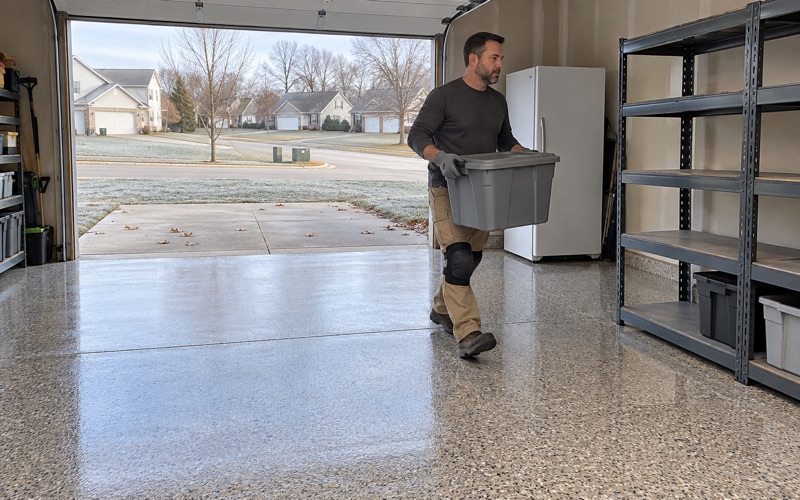
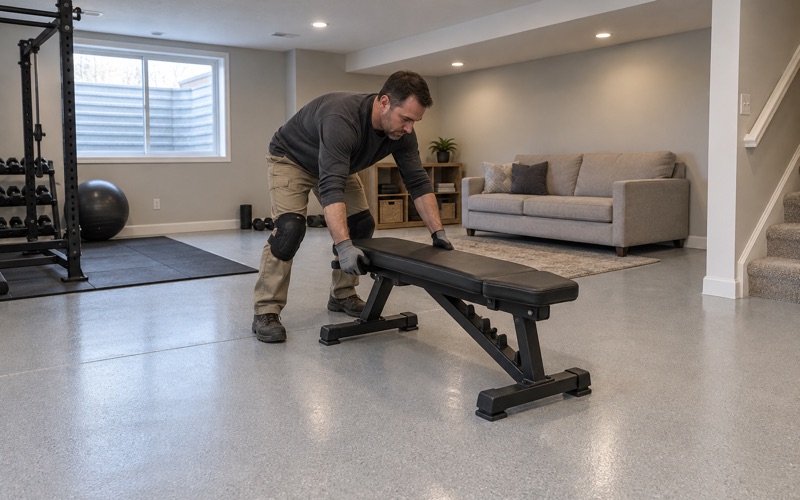
Concrete is not combustible, so on a slab the practical question becomes the second half of the sentence: cleaning. Bare concrete is porous, and finish residue that soaks into it is hard to lift without gouging the surface. A seamless resin system over properly ground concrete gives a smooth, closed surface where overspray can be scraped off instead of being trapped in the pores.
For that kind of room we look at 100% solids epoxy body coats under a polyaspartic or urethane topcoat chosen for the solvents and wiping the room will see. Texture comes from the broadcast and topcoat we specify, not from a slogan, and a finishing floor needs enough grip for a worker without a profile so coarse that it holds residue.
Testing an Old Slab First
Old slabs in old buildings rarely come with a vapor retarder anyone can confirm. We measure with ASTM F2170 in-situ relative humidity probes or ASTM F1869 calcium chloride kits, and moisture is the first warranty exclusion we name before a job is sold. Where readings call for it, a moisture-mitigation primer goes into the written scope rather than appearing as a surprise later.
Residue, Scrapers and Daily Cleanup on a Finishing Floor
The housekeeping half of the standard is where a floor earns its keep. Section (g)(2) says spraying areas are kept as free from the accumulation of deposits of combustible residues as practical, with cleaning conducted daily if necessary, and that scrapers, spuds or other cleaning tools must be of nonsparking material. Section (g)(3) adds that scrapings and residue-contaminated debris are removed immediately, and that rags soaked with finish go into approved metal waste cans emptied at least daily.
Nonsparking Tools on a Resin Floor
A nonsparking scraper is commonly brass, bronze or a hard plastic, and a floor that is scraped every day has to tolerate it. A high-build 100% solids epoxy under a hard topcoat stands up to routine scraping far better than a thin film coat, which can wear through at the spot where the operator stands. We size the finished thickness around how often the floor will be scraped, and we write that thickness into the proposal.
The topcoat matters as much as the build. We choose it for how cleanly dried overspray lets go of it, because a surface that releases residue under a light pass is one the crew will actually keep clean.
Joints, Cracks and Wall Edges
Residue collects wherever a floor changes: saw cuts, cracks, patched spalls and the line where the floor meets the wall. We fill and grind joints flush where the slab allows it, and a coved base can carry the system a few inches up the wall so overspray has no corner to lodge in. Fewer seams mean fewer places a scraper skips and residue builds.
Working Around the Shop
In a shop that builds to order, the finishing room is often the bottleneck. We phase the work into overnight or weekend windows where the schedule demands it, and we follow slab temperature and the dew point spread for cure rather than the calendar, which in an Iowa winter can mean waiting. Grinding dust is captured at the machine with a vacuum, never rinsed toward a drain, which matters in a room where dust and wet finish should never meet. Every quote we write says Marion, Iowa, so there is no confusion about who did the work.
- 20+ Years on Concrete
- Moisture Tested Before Pricing
- Free Written Estimates