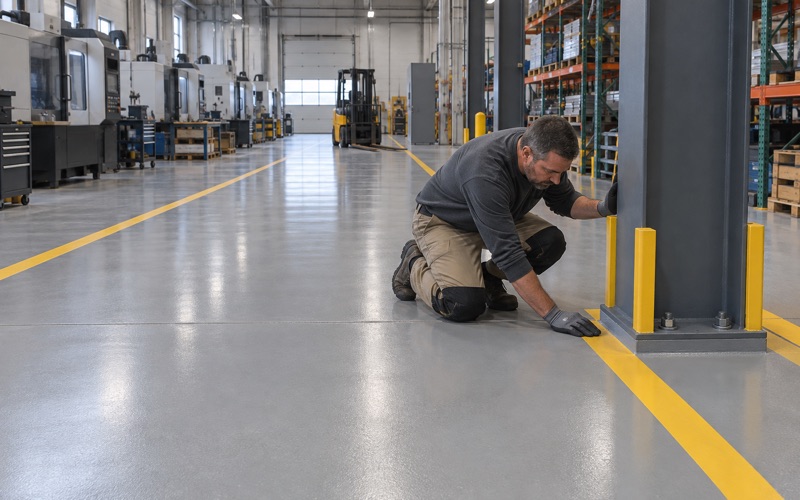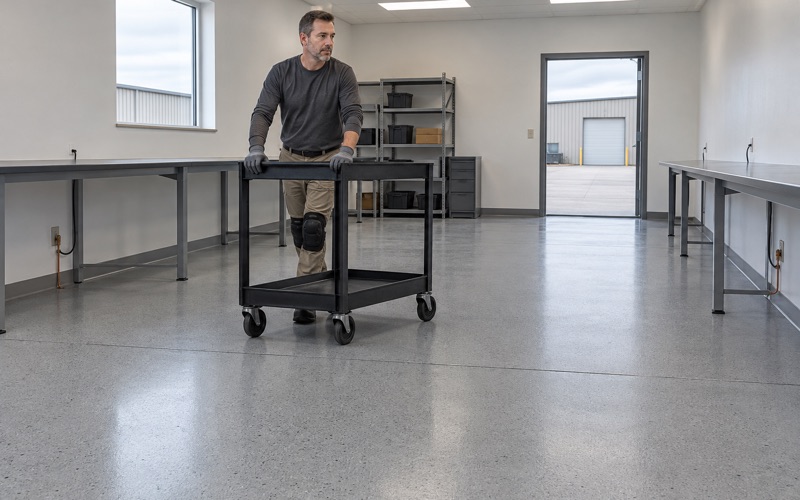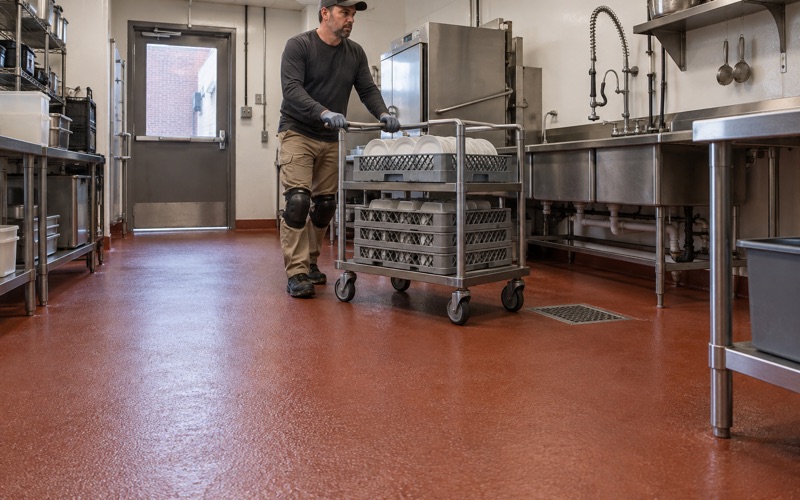
Marion Epoxy Flooring has spent more than 20 years on epoxy flooring in Cedar Rapids and around it, and the jobs that take the most planning are shop floors with a service pit cut into them. A pit bay asks two questions at once: what the coating should be, and what the marking around the pit should look like against it. We answer both on paper before a grinder touches the concrete.
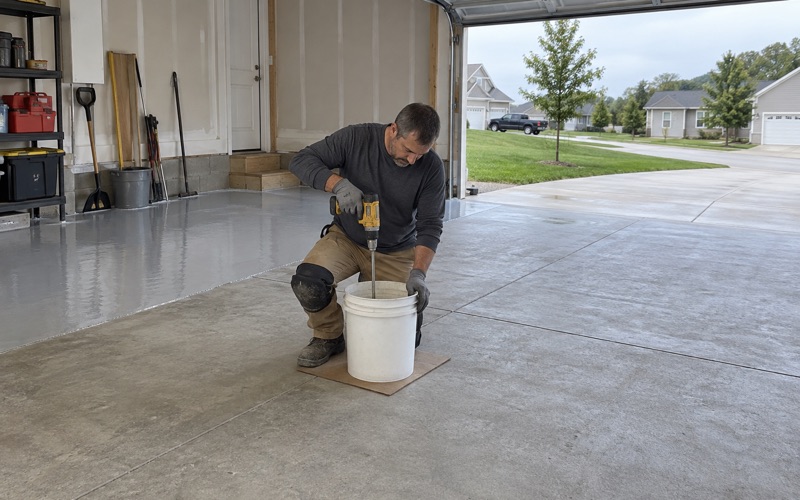
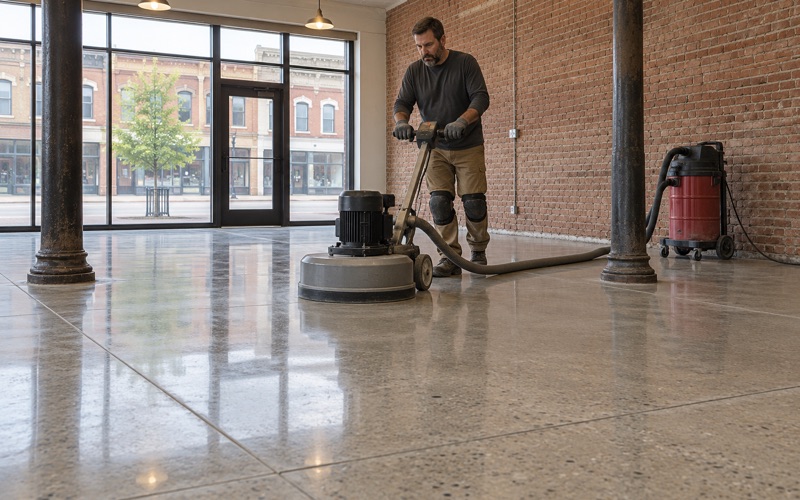
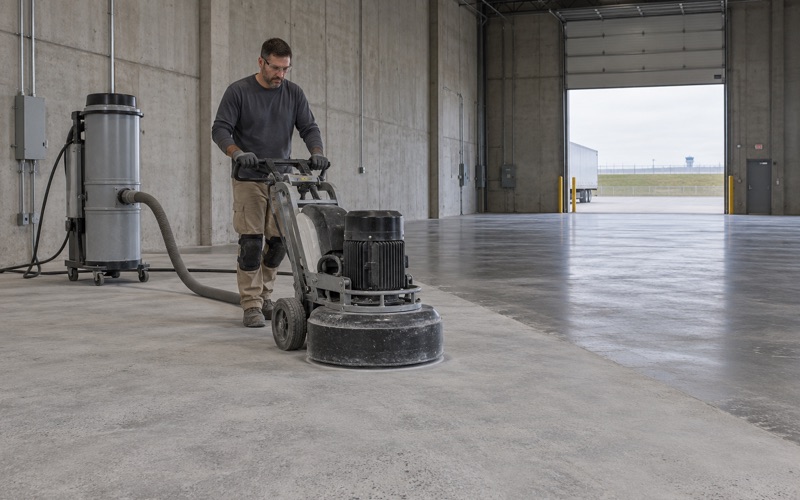
That paper is specific. Our proposal names the product line, the number of coats and the finished thickness, so you can hold the finished floor up against the quote. A moisture test is written into the scope before the price is final, and every slab is opened with a diamond grinder or a shot blaster rather than an acid etch, so the coating has a real profile to bond to.
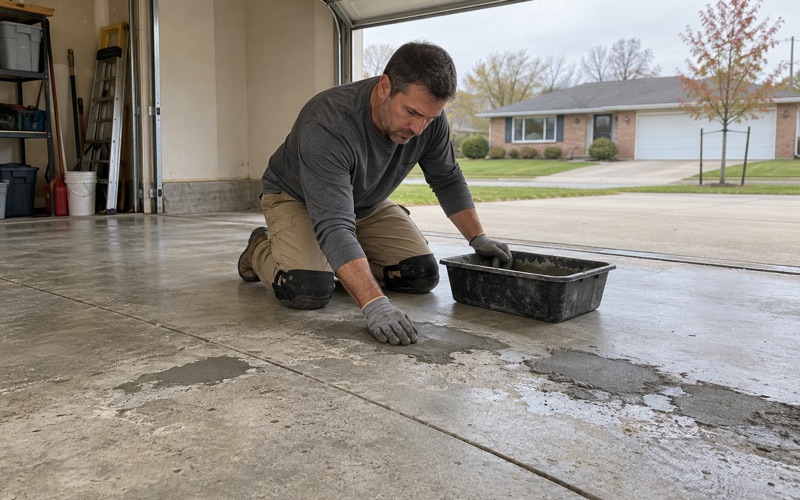
Cracks, spalls and old coatings get mapped on the first visit. When a slab needs repair, or replacement, before it should carry a coating, we tell you that instead of coating over it.
Truck Shops on the Southwest Side and the Rule Around a Pit
Cedar Rapids is the county seat of Linn County and the second-most populous city in Iowa, and freight is a large part of what it does. CRST lists its company address on 1st Street SE, and its Cedar Rapids terminal at 3930 16th Avenue SW runs a shop from 6:00 a.m. to 4:30 p.m. every day. Foodliner began operating a terminal with a full-service truck shop at 5020 18th Avenue SW in October 2023, in a building that once housed CRST’s NADTA driving school.
We have no relationship with either company, and nothing we have read says whether their shops work over pits. We name them because they show the kind of floor the southwest side is full of: heavy vehicles, long shifts and bays where a mechanic may be working below the truck rather than beside it.
Who sets the rule here
Iowa runs its own workplace safety program, so the authority is Iowa OSHA. Under 481 IAC 210.4, Iowa adopts the federal general industry standards in 29 CFR Part 1910, from 1910.20 onward, as the rules implementing Iowa Code chapter 88. Building permits for a shop renovation are a separate matter handled by the City of Cedar Rapids Building Services.
What 29 CFR 1910.28 says about a service pit
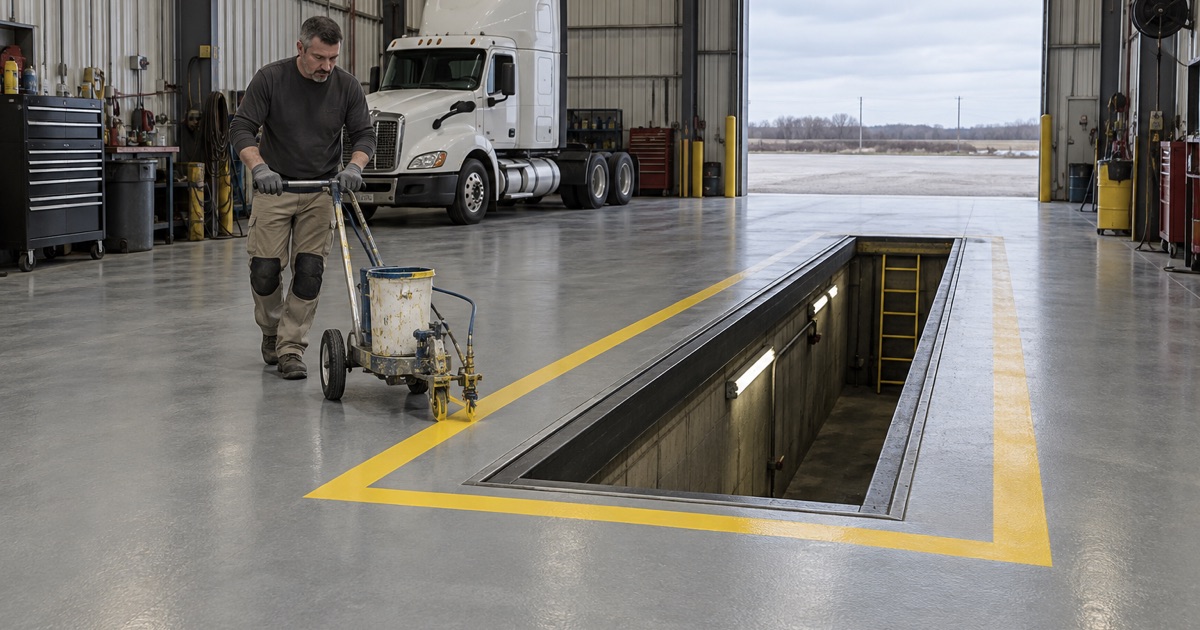
For a repair, service or assembly pit less than 10 feet deep, 29 CFR 1910.28(b)(8) says a fall protection system is not required if the employer does three things. Access within 6 feet of the pit edge is limited to authorized employees trained under 1910.30. Floor markings are applied at least 6 feet from the edge of the pit in colors that contrast with the surrounding area, or a warning line is set at least 6 feet out on stanchions that resist 16 pounds pushed at 30 inches high, or both. And readily visible signs reading “Caution - Open Pit” are posted.
Only one of those three involves the floor. Limiting access and posting signs stay with the employer, which is why we never describe a coating as making a shop compliant.
Looking for epoxy-flooring closer to Mount Vernon? See Mount Vernon Epoxy-Flooring.
Choosing a Floor Color the Pit Marking Can Stand Out Against
The rule asks for contrast and a distance. It does not name a stripe width or a specific color. That leaves the choice to you, and the choice only works if the coating color and the marking color are picked as a pair. A marking that reads clearly on bare gray concrete can disappear once the bay is coated in a similar shade.
Solid fields and busy broadcasts
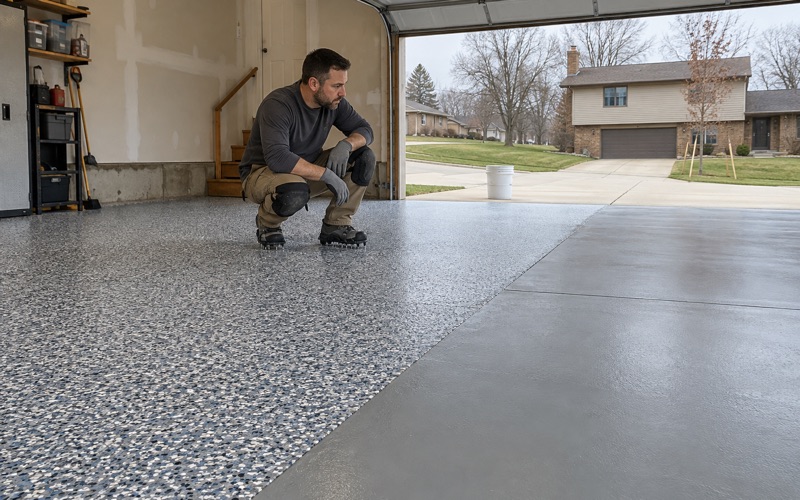
A full vinyl flake broadcast hides dirt well, but its speckled pattern also competes with a painted line. In a pit bay we often suggest a solid-color field around the pit, at least out to the marked zone, with any flake broadcast kept to areas where nothing needs to be read at a glance. A light field with a dark band, or a dark field with a light band, holds its contrast better than two mid-tones.
Building the marking into the system
We can lay the marking as part of the coating rather than as tape or a single coat of paint over it. A band of pigmented 100% solids epoxy set into the base coat, then sealed under a clear polyaspartic or polyurea topcoat, wears with the floor instead of peeling off it. You still decide where the band goes and how wide it is; we lay it where your layout puts it, at least 6 feet from the edge of the pit.
Texture near the pit edge
Shop floors around a pit pick up oil, water and brake fluid. We specify slip resistance by the broadcast and topcoat used, such as a quartz aggregate broadcast locked under the topcoat, rather than promising it as a slogan. Texture does dull a color slightly, so we show you a sample board with the texture on it before the band color is final.
Preparing the slab under the band
Concrete around a pit has usually absorbed years of oil and coolant, and a coating will not hold on a contaminated surface however good the product is. We degrease, then grind or shot blast to an ICRI concrete surface profile matched to the system, and we grind test patches to see how deep the oil has gone. Where it has soaked in too far, we say so and mark that area for repair before any color goes down.
Moisture gets the same attention. We test the slab with ASTM F2170 in-situ relative humidity probes or ASTM F1869 calcium chloride kits, depending on the floor, and the reading goes into the proposal. A shop slab that tests high gets a moisture-mitigation primer, or a frank conversation about whether it should be coated at all.
Several Pits in One Bay
Many truck shops run two or three pits side by side. The rule allows for that: when two or more pits in a common area are not more than 15 feet apart, the employer may place contrasting floor markings at least 6 feet from the pit edge around the entire area of the pits rather than around each one.
Planning one marked zone instead of three
One perimeter around a group of pits changes the coating plan. The floor inside the marked zone sees the heaviest traffic and the most dropped parts, so we may specify a heavier build there than in the parking lanes. We measure the actual pit spacing on site, because whether the pits fall within 15 feet of each other decides whether one marking can serve them all, and that is your call to make with the measurements in hand.
Where the signs and the line meet
The “Caution - Open Pit” signs are yours to post, but their placement affects the floor. Posts set into a coated slab need anchor holes, and drilling after the coating cures chips the edges. If you know where stanchions or sign posts will go, we drill and seal those locations before the topcoat so the line, the posts and the coating finish together.
The pit itself
The pit walls and the curb at its edge are a different surface from the floor above it. Some owners coat the curb in the marking color so the edge reads from across the bay; others leave the pit untouched. We price the pit as a separate line on the proposal so you can decide.
Keeping the Markings Readable as the Shop Floor Wears
A marking that has worn into the floor color no longer does what the rule asks of it. In Cedar Rapids the wear comes from two directions: heavy tires turning on the slab, and the brine and rock salt that ride in from November through March.
Salt, brine and turning tires
We choose shop systems for that salt season, with a topcoat rated for chemical exposure over the base coat. The places where trucks pivot into a bay wear first, and the marked band around a pit is often in exactly that path. We tell you at the walkthrough which stretch of the band will need a fresh topcoat first.
Working around a running shop
A terminal shop that runs every day cannot hand over its floor for a week. We phase the work around shifts, with overnight and weekend windows when a bay cannot close, and we coat one pit bay while the next stays in service. Grinding dust is captured at the machine with a vacuum rather than washed toward a floor drain or into the pit.
Cure schedules follow slab temperature and dew point rather than the calendar. An unheated bay in a Linn County winter is told to wait, because a coating cured too cold can show amine blush and a weak bond, and the marked band would be the first part to fail.
Return to service is planned the same way. A polyaspartic topcoat lets foot traffic back onto a bay sooner than a standard epoxy topcoat, but a loaded tractor is not foot traffic. We give you a written date for parts carts and a later one for trucks, based on the products used and the slab temperature that week.
Recoating before the contrast fades
The cheapest maintenance is a clear topcoat over a band that is dulled but intact. Once the base color has worn through, the band has to be ground and rebuilt. Before any shop job is signed, we explain what the coating warranty leaves out, and moisture coming up through the slab is the first exclusion we name.
Our quotes and invoices say Marion, Iowa, because a search for Marion alone turns up Illinois, Ohio and Florida. When you are ready to plan a shop floor around a pit, we start with the measurements, the moisture test and your marking layout.
- 20+ Years on Concrete
- Moisture Tested Before Pricing
- Free Written Estimates