Marion Epoxy Flooring brings more than 20 years of work to epoxy flooring in Center Junction, and on an older house we do not open the conversation with flake colors or topcoat sheen. We open it with what is coming up through the concrete. A coating bonds to the top of a slab, but the moisture underneath decides whether that bond lasts, so the first question on any job is whether the floor is dry enough to coat at all.
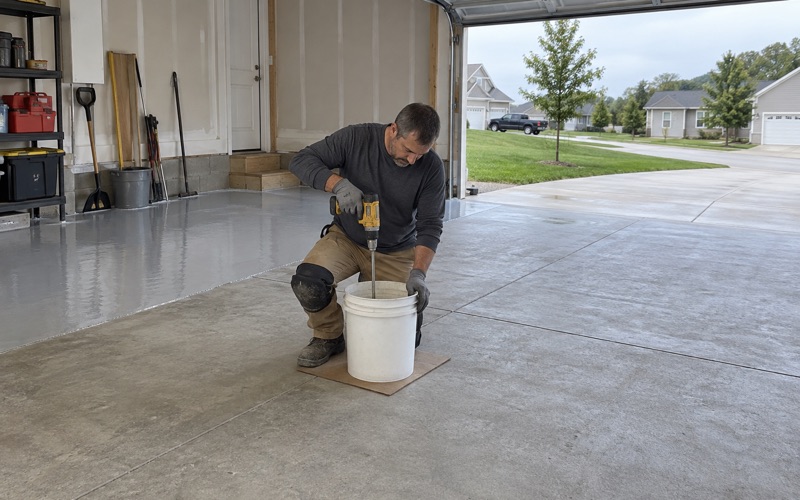
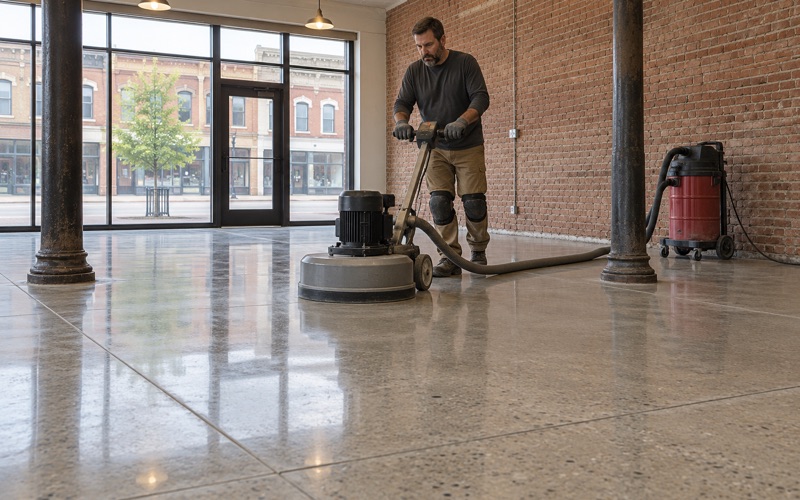
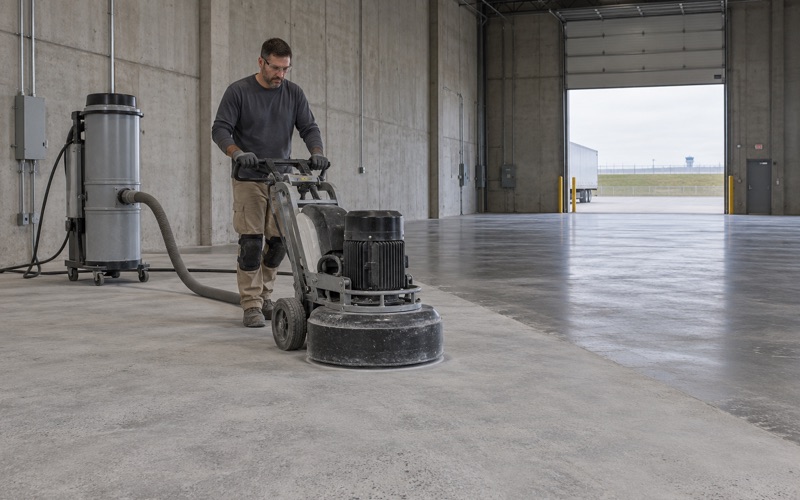
That is why a moisture test sits inside our written scope before a price is final, whether the floor is in a basement or a garage. The proposal names the product line, how many coats go down and the finished thickness, so you can hold the result up against the quote. Prep is mechanical: a diamond grinder or shot blaster cuts a real profile into the surface, and we never rely on acid etching to do that job.
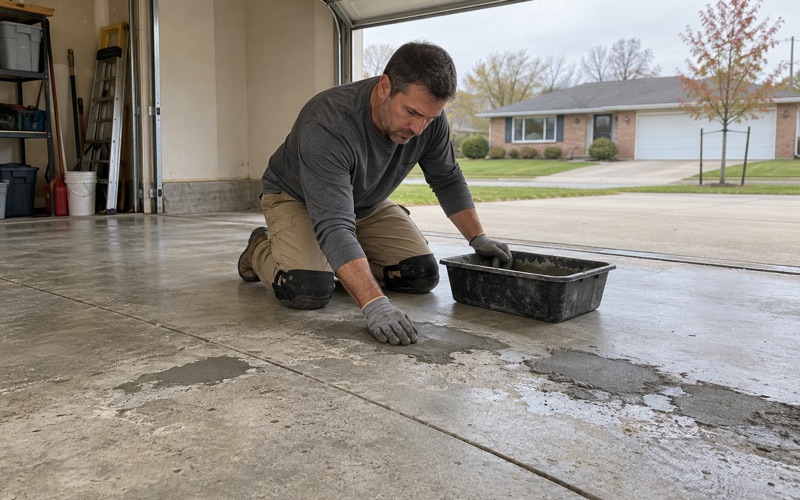
If a slab is cracked, spalled or carrying an old coating that is letting go, we map all of it before quoting and tell you plainly when repair or replacement has to come first. We also walk through what a coating warranty excludes before anything is sold, and moisture is the first exclusion we name.
A Village of Owner-Occupied Houses on Old Slabs
Center Junction is a village of houses, and the housing figures make the point. The Census Bureau’s American Community Survey, in its 2024 five-year estimates, counts 55 housing units in the Center Junction census-designated place. Every one is owner-occupied, and every one is a detached house, with no rentals and no apartment buildings in the estimate. The person asking us about a floor here is almost always the person who owns it and lives on it.
Most of the estimate predates 1940
The same survey puts 36 of those 55 units in the built-1939-or-earlier column, another 19 in the 1960s and 1970s, and none from 1980 onward. For a village that counted 100 residents in the 2020 census, that is a small sample with wide margins, so we read it as the shape of the housing stock rather than a precise count. The shape is still plain: most of what stands here is old. The village itself was laid out in 1871, near the center of Jones County, as a hoped-for rail junction where the Chicago & North Western and Milwaukee Road lines crossed.
Why an old slab gets tested first
An old basement or garage slab is the floor most likely to carry moisture up from below. Concrete poured long before an under-slab vapor retarder became routine may have little between it and the ground, and nobody living in the house today can say for certain what was put down. Decades of settling also leave cracks that give vapor an easier path.
Age raises the odds; it does not make the call. Plenty of old slabs test dry and some newer ones do not, which is why the test result, not the build year, decides what happens next. In a basement we also read the floor for past water before any test goes down: stains along the walls, a tide line, the sump pit if there is one, and the floor drain. A coating does not stop seepage, so water coming in from the side is a separate problem from vapor rising through the slab.
Looking for epoxy-flooring closer to Iowa City? See Epoxy-Flooring in Iowa City.
The 24-Hour Plastic Sheet Test
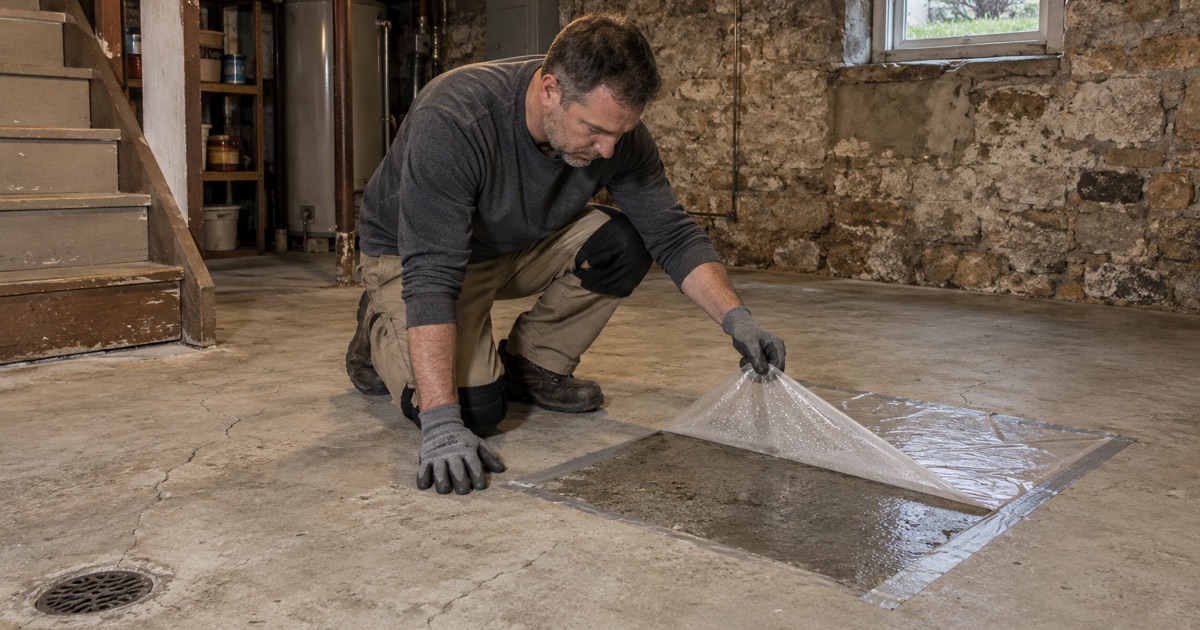
The simplest field check for slab moisture is one a coatings manufacturer prints in its own instructions. Rust-Oleum’s technical data sheet for its Moisture Stop product, ROC-113, tells the user to lay a 2-foot by 2-foot sheet of plastic on the floor, tape the edges down with duct tape, and leave it for 24 hours. If water droplets form on the inside of the plastic, or the concrete under it looks wet and darker in color, moisture is trapped in the floor and has to be treated before coating. We cite that sheet because it states the test plainly; we do not sell, represent or hold any credential from the brand.
How we place the squares
One square tells you about one spot, and moisture is rarely even across an old floor. We tape plastic in several places: near an outside wall, near the floor drain, toward the middle of the slab, and over any patch that already shows staining or a white mineral bloom. Each sheet stays sealed and undisturbed for the full 24 hours. The formal industry version of this check is ASTM D4263, and it is read the same way: condensation or darkening under the plastic is a positive result.
What the result does and does not tell us
A wet square settles the question for now: the floor is not ready for a coating. A dry square is a good sign rather than a guarantee, because the plastic sheet test shows whether moisture is moving, not how much. When a reading looks borderline, or the coating system we are proposing calls for a number, a calcium chloride test under ASTM F1869 measures the vapor emission rate over a set area and gives us one.
Built into the schedule
Because the sheet has to sit for a day, we put it down on the first visit and read it before the price is final. That keeps a moisture surprise from showing up after the grinder is already in the garage.
When the Slab Tests Wet: Treat First, Coat Second
A coating is not waterproofing. It will not stop groundwater, it does not hold back water pushing up under hydrostatic pressure, and we say so in writing on every basement and garage proposal. What a coating can do is perform well on a slab whose moisture has been dealt with first, so a wet result changes the order of the work rather than ending the conversation.
Find where the water comes from
If liquid water is getting in from outside, through a wall crack, the joint where the floor meets the wall, or drain tile that is not keeping up, that is a drainage or foundation question and it gets answered before a coating is discussed. We point out what we see, and we tell you when the right next call is to someone other than a floor contractor.
Treat the slab itself
Where the problem is vapor rising through sound concrete rather than water entering, the slab can often be treated. The options run from a penetrating treatment, such as the modified silicate the Rust-Oleum sheet describes, which it says needs 24 hours before coating, to a moisture-mitigation primer that goes down as the first layer of the system. Which one fits depends on the test result, the condition of the concrete and the coating going on top, and the proposal names it rather than burying it in a line called prep.
Then build the floor
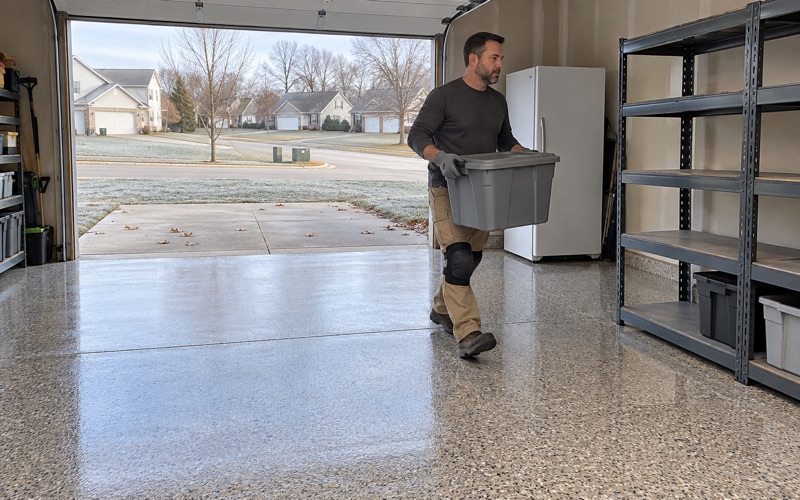
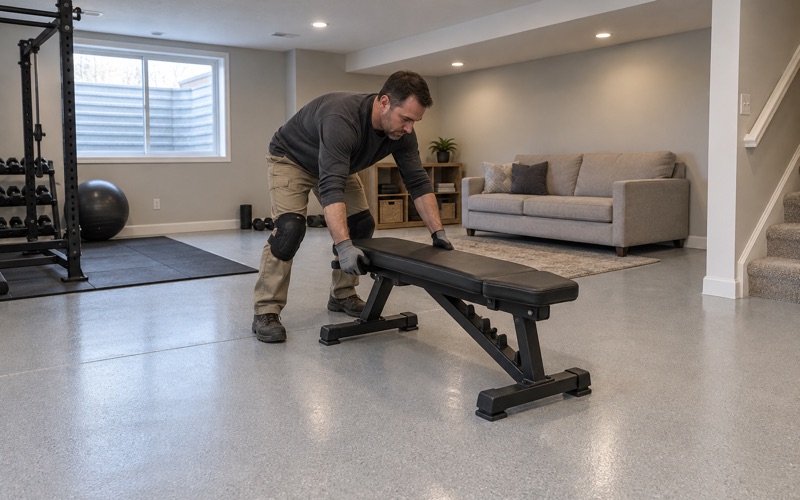
Only after treatment does the slab get ground to profile, repaired and coated. In a basement we often suggest a low-odor system as a comfort and re-entry choice, never because Iowa law requires one. In a garage, the system is chosen to hold up to the brine and rock salt that ride in on tires from November through March, and any slip-resistant texture is specified by the broadcast and topcoat we use rather than promised as a slogan.
Moisture vapor transmission and hydrostatic pressure are standard exclusions in coating warranties, and we explain that before the job is sold. Testing first is how a floor stays clear of that exclusion instead of running into it two years later.
No City Hall Since 2015: Who Runs What Now
Center Junction was an incorporated city until June 2015. After a special election on the plan, the council voted to sell the city’s assets, disband and hand administration to Jones County. Today it is an unincorporated village and census-designated place within the Cedar Rapids metropolitan area, and there is no city hall or city permit office to call.
Water and sewer
The former city water system, first built in 1909 with a well added in 1939, is now owned and operated by Eastern Iowa Regional Utility Service Systems, known as EIRUSS, which took it over as part of the discontinuance. EIRUSS also runs the wastewater system, a public sewer in service since 2008 that replaced the private septic systems the community relied on before. Jones County ordinances set the sewer rates for Center Junction households.
What that means for a floor job
None of this changes how a slab is tested or coated, but it does change who answers the questions around the job. Whether Jones County wants a permit for a particular project is a question for the county, and you should hear the answer from the county rather than from us. We have no arrangement with the county or with EIRUSS; we are a contractor hired to work on a private floor.
Our part is the floor itself. Grinding dust is captured at the machine with a vacuum rather than washed toward a floor drain or sump pit, and the cure schedule follows slab temperature and the dew point spread at the surface, not a date on the calendar.
What the quote will show
Every quote we write says Marion, Iowa, because a search for Marion alone turns up Illinois, Ohio and Florida. For a Center Junction house, the quote will also record where each plastic square went, what it showed, and how that result shaped the system we are proposing.
- 20+ Years on Concrete
- Moisture Tested Before Pricing
- Free Written Estimates