
Marion Epoxy Flooring installs commercial epoxy flooring in Marion, IA, serving surrounding cities including Hiawatha, Cedar Rapids, Mount Vernon, Stone City and Anamosa. With 20+ years of commercial and residential floor work, we build floors for retail stores, offices, clinics, auto and fleet service bays, gyms, veterinary practices, schools and rental properties, and we plan every job around the business that has to keep running on top of it.
A commercial floor faces a different set of demands from a garage at home. It has to handle foot traffic all day, carts and equipment, cleaning routines set by staff rather than an owner, and sometimes the scrutiny of inspectors and customers alike. It also has to be installed without closing the business longer than absolutely necessary.
Our commercial work follows the same basics as every floor we install: grind the slab rather than etch it, test the concrete for moisture as part of the written scope, and name every product and coat in the proposal. What changes is the scheduling, the specification and the coordination with your team. Plant floors and commercial kitchens have their own pages, because their washdown and chemical demands are different again.
Commercial Floors by Business Type
Retail Stores and Showrooms
Retail and showroom floors need to look sharp under bright lighting and hold up to steady foot traffic and display moves. Solid color, flake and metallic epoxy systems all work here, finished with a topcoat that resists scuffing and ultraviolet ambering from storefront windows.
Older storefronts, including buildings in the Uptown Marion Commercial Historic District, often hide a slab under several layers of tile and glue. We grind those back to sound concrete, repair what we find and match the floor system to the tenant moving in.
Offices, Clinics and Veterinary Practices
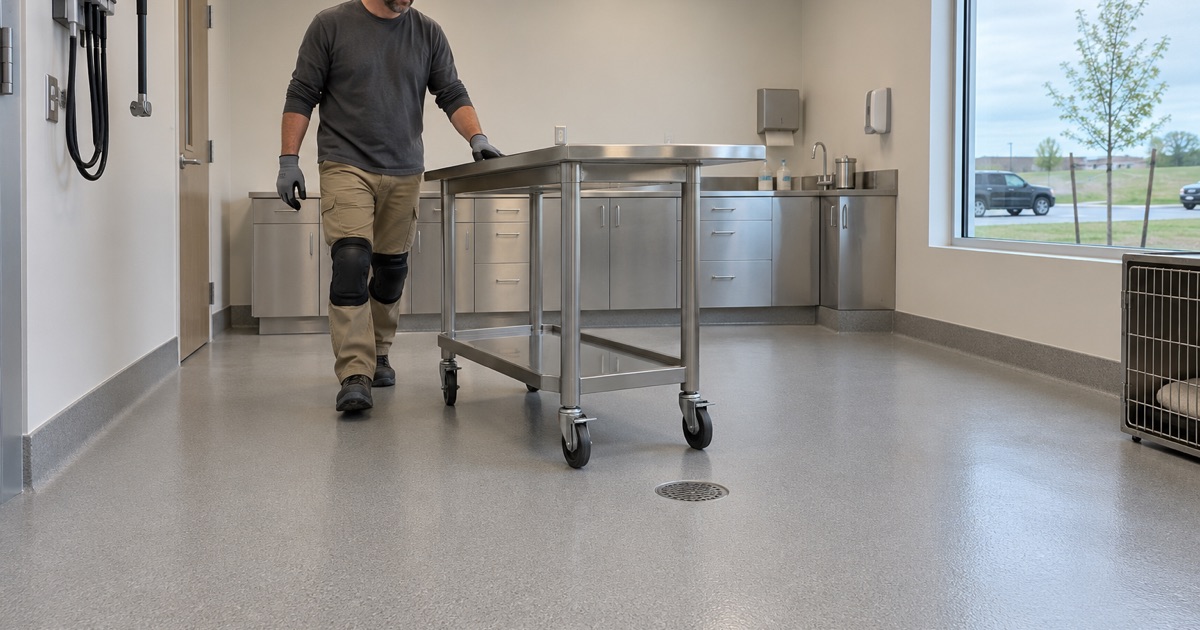
Clinics and veterinary practices need floors that clean thoroughly, resist disinfectants and do not trap dirt in seams the way tile grout can. A seamless epoxy floor with an integral coved base at the walls makes cleaning faster and more complete.
Offices tend to care more about appearance and noise. We often pair a decorative system with a satin topcoat that hides wear, and we work after hours so staff return to a finished space rather than a construction zone.
Auto and Fleet Service Bays
Dealership service departments, repair shops and fleet garages put floors through hot tires, jacks, dropped tools and spills of oil, coolant and brake fluid. We build these floors thick, with a chemical-resistant topcoat and texture where fluids collect.
Bright, light-colored floors are popular in service bays because they reflect light and make leaks and dropped parts easy to spot. Bay lines and walkway striping can be built into the coating so they do not wear off like paint.
Gyms, Schools and Rental Properties
Fitness centers need a floor that handles dropped weights and sweat, often combined with rubber flooring in lifting areas. Schools and public buildings need durable, easy-to-clean floors in corridors, locker rooms and mechanical spaces.
Apartment owners and property managers use coated floors in laundry rooms, storage areas, garages and stairwells, where a cleanable surface cuts turnover costs. We schedule around tenants and coat common areas in sections.
Specifying a Commercial Floor System
Matching the System to the Use
We start with how the floor is used: the traffic, the cleaners, any chemicals or hot water, wheeled equipment and how the space must look. Those answers decide the base coat, broadcast, topcoat and thickness.
The proposal lists each product, the number of coats and the finished thickness, so your facilities team can check the floor against the bid and plan maintenance later.
Slip Resistance by Area
A commercial floor rarely needs the same texture everywhere. Entries that take snowmelt, restrooms, wet areas and ramps need more grip, while display areas and offices can stay smoother and easier to clean.
Texture comes from the broadcast and the topcoat, and we specify it area by area instead of promising slip resistance as a slogan.
Moisture and Slab Condition
Commercial slabs often carry old coatings, adhesives, curing compounds and years of patching. We map all of it, grind to sound concrete and test for moisture before the price is final, because vapor coming up through a slab will lift a coating in a commercial building just as it would in a basement.
Where readings run high, a moisture-mitigation primer goes into the specification and the proposal explains why.
Scheduling Around Your Business
Phased, Night and Weekend Work
Most businesses cannot close for a week while a floor cures. We divide the space into phases, work overnight or on weekends and use fast-curing polyaspartic systems where they suit the use, so each section returns to service quickly.
We agree the phasing plan with you before the job starts, including where customers and staff will walk and when each area will reopen.
Dust and Odor in Occupied Buildings
Every grinder runs with a vacuum attached, and work areas are sealed off from the rest of the building. Low-odor coatings are offered for occupied spaces, not because Iowa requires them, but because people in the building notice.
We also keep grinding slurry out of floor drains and storm inlets, which matters for buildings that discharge to the city system.
Winter Installs in Commercial Buildings
Heated commercial buildings can usually be coated year round, but loading docks, overhead doors and unheated storage areas behave like a cold garage. Coatings cure slowly on a cold slab, and moisture condensing near the dew point causes amine blush and weak bonds between coats.
We measure slab temperature and dew point spread before each coat and ask that dock doors stay closed during the cure. Where an area cannot be kept warm, we schedule it for milder weather rather than risk a floor that never fully hardens.
Care and Recoating
Cleaning a Commercial Epoxy Floor
Most coated commercial floors clean with an auto-scrubber or damp mop and a neutral cleaner. Harsh degreasers and abrasive pads can dull a topcoat faster than traffic does, so we leave written care instructions matched to the products on your floor.
Walk-off mats at entries catch the grit and salt that do most of the wear in an Iowa winter, and they are the cheapest way to extend the life of the finish.
Planning a Recoat
A well-bonded commercial floor rarely needs to be stripped. When the topcoat shows wear in traffic lanes, it can be abraded and recoated, often over a weekend, which restores the finish at a fraction of the cost of a new system.
- 20+ Years on Concrete
- Moisture Tested Before Pricing
- Free Written Estimates