
Marion Epoxy Flooring installs industrial epoxy flooring in Marion, IA, serving surrounding cities including Hiawatha, Cedar Rapids, Mount Vernon, Stone City and Anamosa. With 20+ years of floor work in shops, plants, warehouses and service buildings, we specify every industrial floor from the loads, chemicals and cleaning it will face, and we phase the work around shifts so production does not have to stop for longer than it must.
Industrial floors fail in predictable ways. Forklifts break joint edges, dropped parts chip thin coatings, hot water and solvents soften the wrong resin, and coatings rolled onto oil-soaked concrete peel in sheets. Each of those failures is avoidable, but only if the floor system is chosen for the actual conditions rather than taken from a catalog.
The Marion area has a long industrial streak, from electric motor manufacturing and process equipment builders to food processors, distribution centers and the farm equipment dealers that serve eastern Iowa. Our industrial work starts with a walk of the floor with the people who use it, because they know where the spills, impacts and traffic actually happen.
Floors for Manufacturing and Machine Shops
Oil, Coolant and Dropped Parts
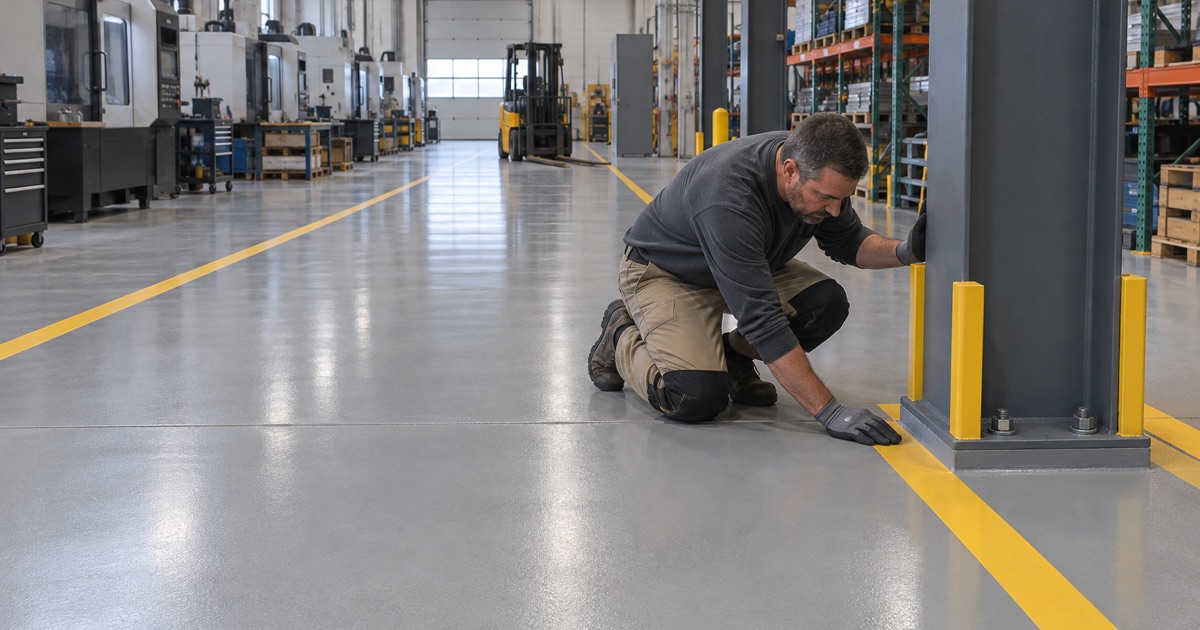
Machine shops and fabrication floors see cutting oil, coolant, hydraulic fluid and heavy steel parts dropped from benches and hoists. A thin coating chips and stains in months, so we use thicker high-build or slurry epoxy systems with a chemical-resistant topcoat in these areas.
Oil-soaked concrete is degreased and ground back until the slab is clean enough to bond. Skipping that step is the most common reason shop floors peel around old machine locations, and it is the step we spend the most time on in older plants.
Motor Shops and Varnish Areas
Electric motor repair and manufacturing shops handle varnish, solvents and resins that attack some coatings. We check the specific chemicals in use against the topcoat’s resistance data and specify a system that will not soften or stain where varnish drips and solvent wipes are routine.
Around dip tanks and bake ovens, heat and chemical exposure combine, so those zones may need a different product from the rest of the floor. The proposal shows exactly which system goes where.
Process Equipment and Assembly Floors
Assembly areas for process equipment and machinery need floors that stay clean, stay flat and let small dropped parts be found quickly. Light-colored, smooth coatings with defined walkways and work cells are common choices.
Where sensitive electronics are assembled or tested, a static-dissipative or ESD floor may be required instead, and we cover that on its own page because the specification is different.
Food Plants and Washdown Floors
Urethane Cement for Hot Washdown
Food plant floors are washed down every shift with hot water and cleaners, and they often sit near ovens, fryers or freezers. Urethane cement handles that thermal shock and the acids and fats found in food processing far better than standard epoxy.
We install urethane cement in slurry or trowel-applied thicknesses depending on the exposure, with texture specified for wet traffic and integral coved bases at walls and equipment curbs.
Drains, Slopes and Coved Bases
Washdown floors need water to leave quickly. We maintain or build slope to trench and floor drains, terminate the coating cleanly into drain bodies and form coved bases so water does not collect at the wall line where bacteria can hide.
We also coordinate with your sanitation and quality teams about cleaners and inspection requirements before the specification is final.
Warehouses, Distribution and Farm Shops
Forklift and Pallet Jack Traffic
Warehouses and distribution centers wear their floors at turning points, dock plates and joints. We rebuild broken joint edges, fill joints with semi-rigid material and use abrasion-resistant topcoats that stand up to constant rolling loads.
Large warehouse slabs are sometimes better served by a densified, polished finish rather than a coating, and we will price both when the slab could reasonably take either.
Striping and Safety Markings
Aisle lines, pedestrian walkways, forklift zones, staging areas and hazard markings can be built into the coating system. Built-in lines wear with the floor instead of flaking off like paint, and they can be laid out in colors that match your safety program.
We set out the layout with your safety and operations staff before the topcoat goes down, so lines land where people and equipment actually move.
Farm Shops and Equipment Dealer Bays
Farm shops and ag equipment dealer service bays deal with mud, manure, hydraulic fluid, fertilizer residue and tracked machinery. Thick, textured coatings make those floors easier to scrape and wash and keep fluids out of the concrete.
Winter brings salt and slush into these bays too. A sealed floor keeps salty meltwater on the surface where it can be squeegeed to the drain, rather than soaking in and scaling the slab.
Installing Around Production
Phasing Around Shifts
We phase industrial floors around production schedules, working overnight, on weekends or during planned shutdowns. Each zone is isolated, ground with dust captured at the machine, coated and returned to service before the next is opened.
Fast-curing systems shorten the time each zone is out of service, and we agree the sequence and return-to-service times with you before work begins.
Moisture, Temperature and Documentation
Industrial slabs are tested for moisture as part of the written scope, because vapor drive lifts coatings in plants as surely as in basements. Slab temperature and dew point are measured before every coat, which matters near loading docks and in unheated buildings.
Your proposal lists each product, the number of coats and the finished thickness, and we hand over data sheets and care instructions for your maintenance records.
- 20+ Years on Concrete
- Moisture Tested Before Pricing
- Free Written Estimates