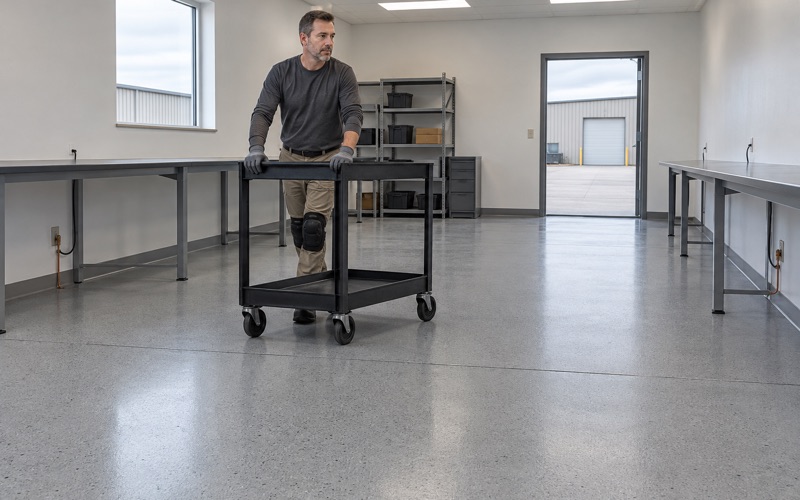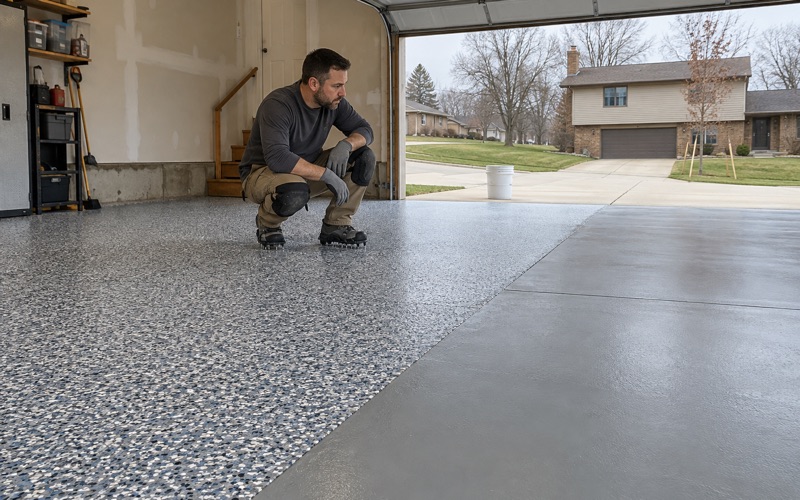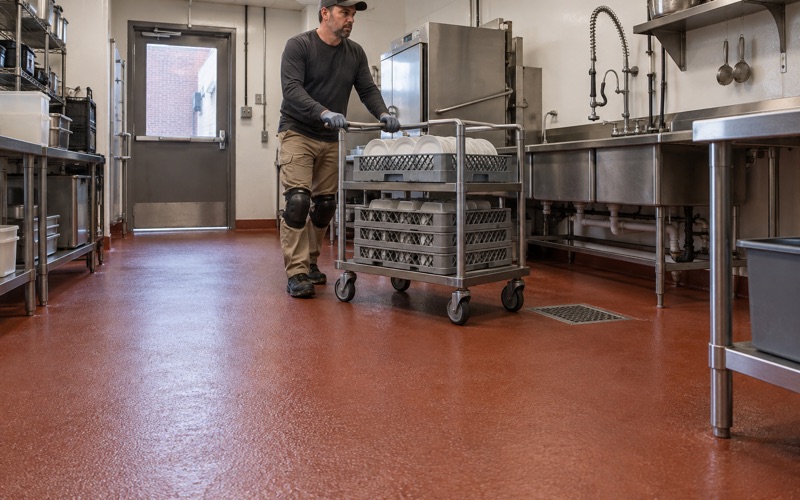
Marion Epoxy Flooring brings more than 20 years of epoxy-flooring work to Monticello, and the first question we ask on any slab here is a simple one: who, or what, is going to walk on it? A garage floor, a shop floor and a kitchen floor each want a different finish, and a floor that carries animals wants something different again. Getting that answer right decides the product, the texture and sometimes whether a coating belongs on the slab at all.
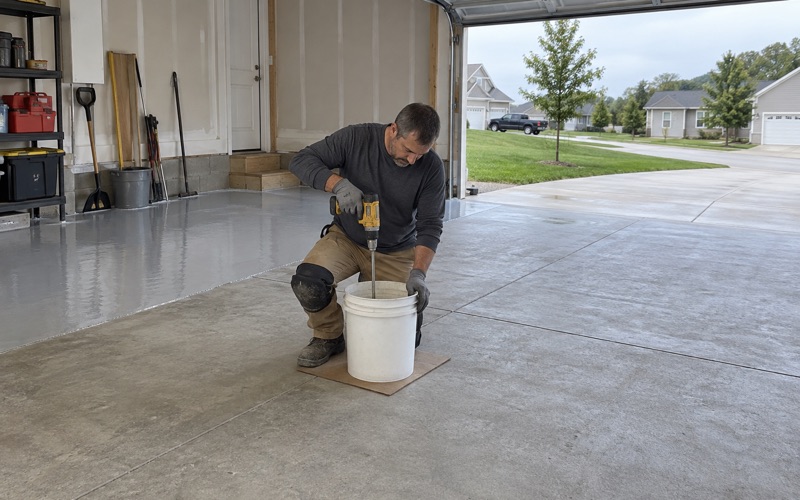
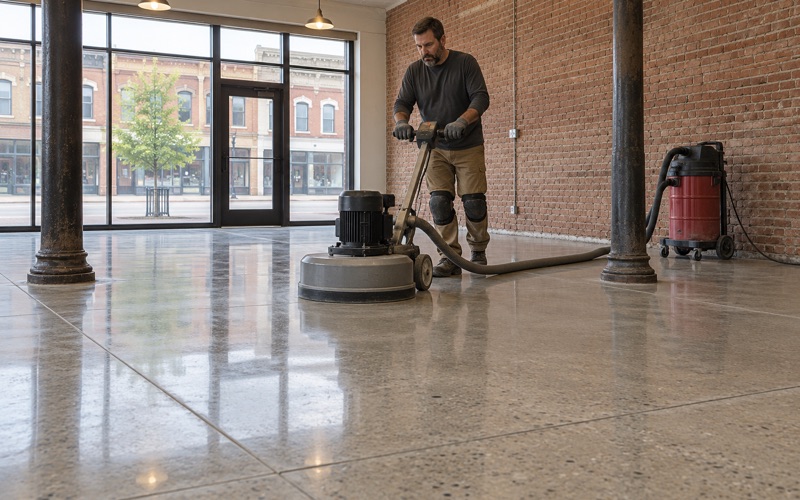
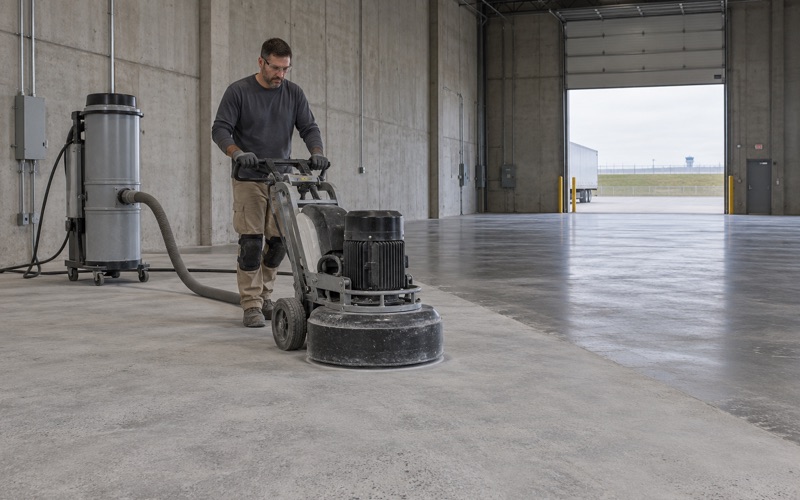
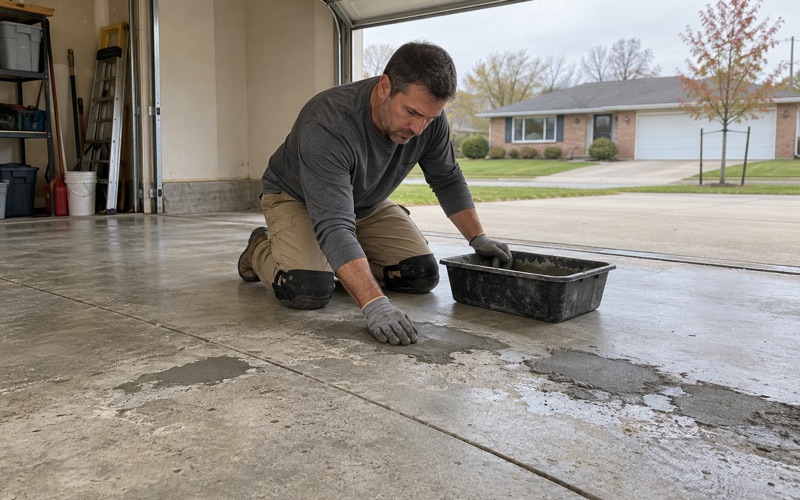
Every floor we coat starts with a diamond grinder or a shot blaster rather than an acid etch, so the resin has an open profile to bite into. Before a price is final, a moisture test is written into the scope, and the cracks, spalls and old coatings are mapped so you know whether the slab needs repair first.
Our proposals name the product line, the number of coats and the finished thickness, which means you can hold the floor up against the paper when the job is done. We also write “Monticello, Iowa” on every quote, because a search for the town name alone tends to return the Minnesota city instead.
Hoof Ground and Shoe Ground on the Fairgrounds
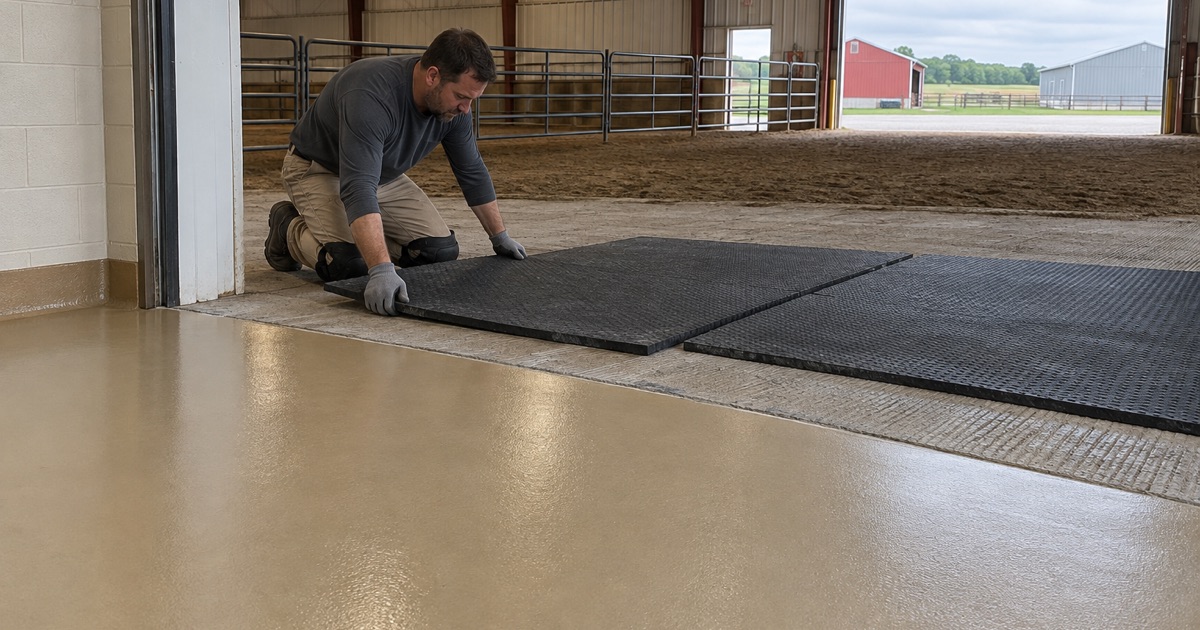
The clearest local example of why traffic matters sits on North Maple Street. The Great Jones County Fair grounds hold two very different kinds of floor within walking distance of each other, and the difference between them is the whole lesson of choosing a coating. We have no connection with the fair, its board or any of its vendors; we point to the grounds because they show the problem plainly.
A covered arena that runs all year
The Jones County Equestrian Center describes itself as a fully covered, full-size arena offering year-round riding for riders of all ages and skill levels, and its gallery shows pole bending and barrel racing. A 2017 plan reported by the Monticello Express called for a 125-by-230-foot arena that would absorb the old arena and an adjacent block barn, alongside a two-story enclosed building. An arena’s riding surface is footing, not a coating substrate, and nothing we sell goes there.
The rooms people use
The same building is rented for events. The fair’s rental contract lists an indoor capacity of 75 and a “Limited Kitchen,” and it states that pets are not permitted inside the Equestrian Center or the Youth Development Center buildings, with the exception of ADA-protected service animals. That one rule splits the property neatly: animals belong to the arena side, and shoes belong to the indoor rooms.
Why that split matters for a floor
A floor built for people is judged on how easy it is to clean and how it looks after a busy weekend. A floor built for horses is judged on whether a shod hoof can stay planted on it when it is wet. Those two goals pull in opposite directions, and a single glossy finish cannot serve both. We have not seen the floors inside the Equestrian Center and do not know how its aisles or service areas are finished; the point is the general one any barn, show facility or hobby stable in Jones County faces.
Looking for epoxy-flooring closer to Center Junction? See Center Junction Epoxy-Flooring.
Why Glossy Concrete Fails a Horse
Most people picture an epoxy floor as smooth and shiny, and in a garage or a showroom that is often exactly what the owner wants. Under a horse it is the wrong instinct. Hooves, especially shod ones, carry a lot of weight on a small contact area, and a surface that feels fine under a rubber boot sole can be treacherous under steel.
What extension guidance says about troweled slabs
Penn State Extension’s guide to horse stable flooring and drainage, updated in 2016, is direct about it. Steel troweling brings fine aggregate and cement to the top of the slab, “forming a glazed and slippery surface.” Wood-float and broom finishes give better traction, the guide notes, but they tend to become smooth with wear. That is guidance from a land-grant university, not a building rule, and it does not recommend or approve any coating.
A coating can make the same mistake
A standard epoxy or polyaspartic topcoat rolled over a slab adds its own layer of gloss. Put that in a horse aisle and you have rebuilt the glazed surface the extension guide warns about, only with a sealed, nonporous skin that sheds water instead of soaking it up. When a client asks us to coat an animal area, we explain that problem before we quote anything, and we do not describe any finish as certified safe for horses, because no such certification exists for these products.
When texture is enough, and when it is not
Where a coating does go near animals, the texture has to be specified, not promised. We build it from the broadcast and the topcoat: a heavy quartz aggregate broadcast locked in with a thinner topcoat leaves far more grit at the surface than a decorative vinyl flake. Even so, aggregate wears, and a coated aisle will lose some bite over the years, much as the extension guide says a broomed slab does. For some floors, honest advice is that a rougher bare finish or a mat will serve the animal better than anything we could apply.
Wash Areas and Aisles: Rough, Grooved or Matted
The two parts of a horse building that most often end up wet are the aisle and the wash area, and the extension guidance handles both bluntly. These are also the two places owners most often ask us to coat, usually because the concrete has gone dingy and they want it to look clean.
Aisles stay rough
For aisleways, Penn State Extension says concrete can become slippery, especially with wear, and that if concrete is used, owners should “use only roughened concrete.” That leaves very little room for a smooth decorative system. If an aisle has worn glassy, the job we would talk through first is restoring a rough profile with grinding or shot blasting, not sealing over the slick surface with something slicker.
What a wash area needs
A wash area, in the guide’s words, needs a floor that is both nonslip and impervious to water. The options it lists are very rough or grooved concrete, textured rubber mats over concrete, and sealed, large-aggregate asphalt, with the floor sloped toward a drain at the side or back. Notice that a coating is not on that list. A coated wash bay would have to carry an aggressive broadcast to come close, and in many cases a textured rubber mat over sound concrete is the simpler, more forgiving answer.
How we approach an animal-side floor
If a coating still makes sense for a tack room, a feed room or a washdown corner, the prep is the same as everywhere else: the slab is ground or blasted to a real profile, and the grinding dust is pulled into a vacuum at the machine rather than rinsed toward a drain. We map cracks and spalls before pricing, and we say so in writing when a slab should be repaired or replaced before anything goes on it. A barn slab that sat for decades without a vapor retarder also gets a moisture test before we commit to a product.
Kitchens, Restrooms and Lobbies: Where Smooth Belongs
On the people side of a building, the logic flips. A lobby, a restroom or a small serving kitchen is cleaned with a broom and a mop, and the Youth Development Center’s own rental terms ask renters to sweep the entire floor and mop any spills after an event. Those are the rooms where a dense, seamless, easily cleaned coating earns its place.
Food floors in Jones County
A kitchen used year-round is held to the FDA Food Code that Iowa adopts. The code wants floors smooth, durable and easily cleanable, with an exception for antislip floor coverings used for safety, and it wants floor and wall junctures coved and closed. We plan commercial kitchen floors around those sections, with coved bases and a texture specified for the wet zones near sinks and dish areas. Food-service floors in Jones County answer to Linn County Public Health, which handles inspections for both counties under contract with the state.
Permits and local rules
In October 2019 the City of Monticello passed Resolution 19-148, forming a committee to study the potential adoption of a building code and invite Anamosa and Jones County into the discussion. We did not find whether a code was adopted afterward, so before a commercial job we confirm the current requirements with City Hall rather than assume either way.
Scheduling and warranty terms
Cure schedules follow slab temperature and the dew point at the surface, not the calendar, so an unheated building in January may be told to wait. Shop and commercial rooms can be phased around business hours, with overnight or weekend windows. Before you sign, we walk through what the warranty leaves out, starting with moisture vapor transmission and hydrostatic pressure, so the exclusions are understood up front instead of discovered later.
- 20+ Years on Concrete
- Moisture Tested Before Pricing
- Free Written Estimates