Marion Epoxy Flooring has handled epoxy-flooring in North Liberty as part of more than 20 years spent coating concrete in eastern Iowa, and every job here starts with one question: what will this floor actually have to survive? A garage floor fights salt brine and hot tires. A kitchen floor fights water, grease and a health inspector. A floor beside a brewing kettle fights heat, and that last one changes which material belongs on the slab at all.
We answer that question in writing before a price is final. Our proposals name the product line, the number of coats and the finished thickness, so you can hold the installed floor up against the quote. A moisture test sits inside that same written scope, and we explain what a coating warranty leaves out before anyone signs, with moisture vapor named first.
Heat is the thread through most of this page, because it is the load that decides whether a thin resin film or a thicker cement-based screed is the right call. The same reasoning carries into the kitchens and garages further down: match the system to what the room does, not to what looks good in a brochure.
A Brewery on Liberty Way and the Heat Its Floor Takes
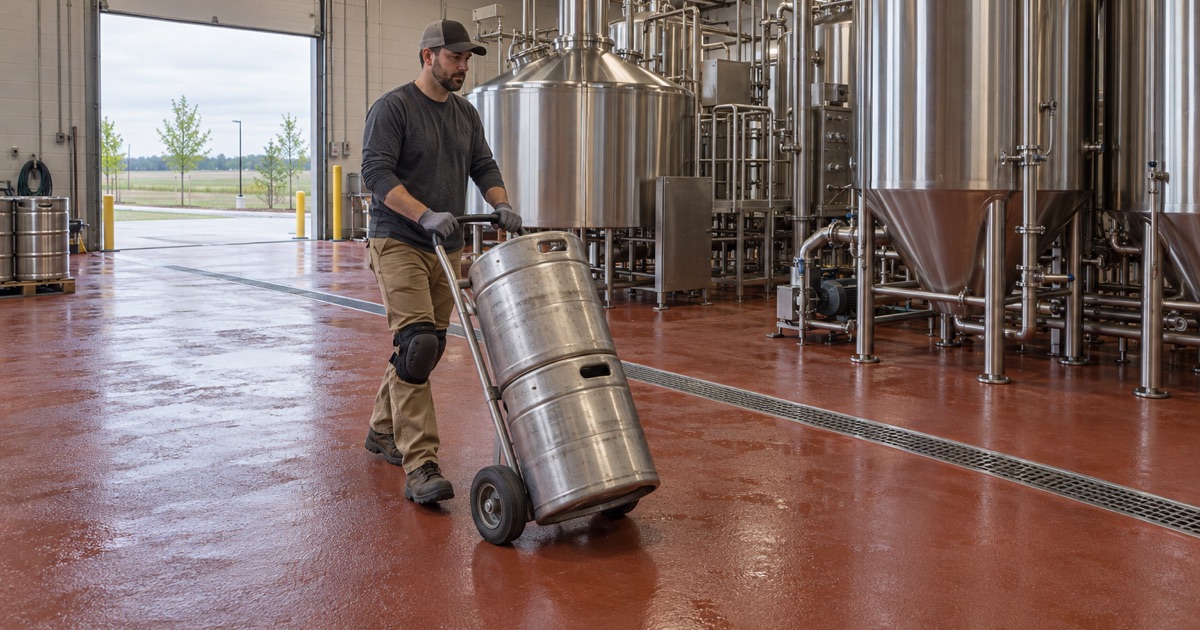
The city’s first brewery and taproom
Field Day Brewing Company sits at 925 Liberty Way. The North Liberty City Council unanimously approved its site plan on January 25, 2022, for what the Corridor Business Journal described as a 20,910-square-foot micro-brewery, restaurant and entertainment facility. The builder, Waldinger, lists it as North Liberty’s first brewery and taproom, completed in August 2023 with capacity to produce 3,000 barrels of beer.
We have never worked for Field Day, and no source we found describes what is installed on its brewhouse, taproom or kitchen floors. We name it because it shows something worth understanding about concrete in this city: a production space where near-boiling liquid meets the floor as part of the daily routine, a short walk from rooms where people sit down to eat.
Hot wort, boiling water and cleaning cycles
Brewing moves a lot of hot liquid. Wort leaves the kettle close to boiling, water is heated for mashing and rinsing, and clean-in-place cycles push hot cleaning solution through tanks and lines before it drains away. Resin-flooring makers describe brewery thermal shock as coming from wort or water above 180 degrees spilled or hosed onto a cold floor, or from hot cleaning cycles discharging across it.
The rest of that slab stays cool. Concrete on grade holds a fairly steady temperature, so the top fraction of an inch of coating can swing from room temperature to near boiling in seconds while the concrete beneath it hardly moves. That sudden gap between the surface and the substrate is the stress a brewhouse floor has to absorb, over and over, for as long as the kettles run.
The cleaning chemistry matters too. Caustic and acid washes call for a chemical-resistant system, but in a brewhouse the heat is usually the load that rules a material out first.
Looking for epoxy-flooring closer to Amana? See Epoxy-Flooring in Amana.
Why a Rigid Coating Can Crack Under Thermal Shock
Two materials expanding at different rates
Every material grows when it warms and shrinks when it cools, and each does so at its own rate, measured as a coefficient of thermal expansion. When a coating and the concrete under it share a similar rate, they move together. When the coating expands much faster or slower, the bond line between them takes the difference as stress every time the temperature jumps.
Flowcrete, a resin-flooring maker, has written that epoxies in breweries have faced issues because their thermal expansion differs too widely from the concrete they are installed on. A thin, hard film cannot stretch to make up that gap, so the stress shows up first as hairline cracks, then as edges that lift, and finally as sections that let go from the slab. Once liquid gets under a loose patch, the damage spreads faster than anyone can patch it.
What we ask before choosing a system
Those are vendor statements, not tests of any North Liberty floor, and we treat them that way. What they give us is a set of questions: how hot does the liquid get, how often does it hit the floor, and which path does it take before it reaches a drain? A room that sees an occasional spilled coffee is not a room that sees a kettle emptied every brew day.
We also map cracks, spalls and old coatings across the slab before recommending anything. A moving crack will telegraph through any coating, and a slab already broken up by heat or impact may need repair or replacement before a new system goes down. When that is the case, we tell you so rather than selling a coat over the problem.
Commercial work also brings the city into it. North Liberty’s Building Inspection Department enforces the 2021 International Building Code among its adopted codes, and its published page does not list permit exemptions for finish work, so we ask the department before assuming a coating-only job is exempt.
Urethane Cement in the Brewhouse, Something Else in the Taproom
What a urethane cement screed is
Urethane cement, also sold as polyurethane-cement, blends polyurethane resin, cement and aggregate into a screed that is troweled on rather than rolled on as a film. One maker’s data sheet, the Sika PurCem FS sheet dated February 2023, lists dairies, breweries, wineries and distilleries among its typical areas and describes a coefficient of thermal expansion similar to concrete, so the screed moves with the substrate through normal thermal cycling.
That same sheet gives a service range from -40 to 248 degrees F and says the material is steam cleanable at 1/4 to 3/8 inch thick. It allows aggregate to be broadcast into the wet screed for better traction, and it says the product may only be used by experienced professionals. We cite one sheet to explain the mechanism, not to endorse a brand, and no screed makes a floor immune to heat, poor preparation or a slab that is already failing.
Different rooms, different floors
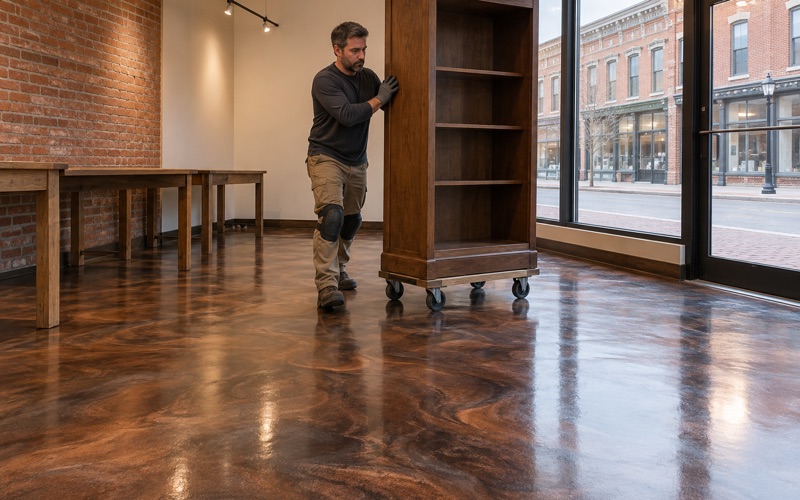
A building with a brewhouse, a taproom and a kitchen holds three floors, not one. The brewhouse takes the heat and the cleaning chemistry, so urethane cement is the usual candidate there. A taproom floor sees foot traffic, beer spilled at drinking temperature, chair legs and nightly mopping, and a 100% solids epoxy with a quartz aggregate broadcast or a polyaspartic topcoat can handle that with a much wider range of colors and finishes.
The kitchen sits between the two. It sees hot water and grease, and it answers to an inspector, so it gets its own plan. Where rooms meet, we detail the transition so each system ends cleanly at a joint instead of one material being stretched across a doorway it was never chosen for.
Preparation does not change with the material
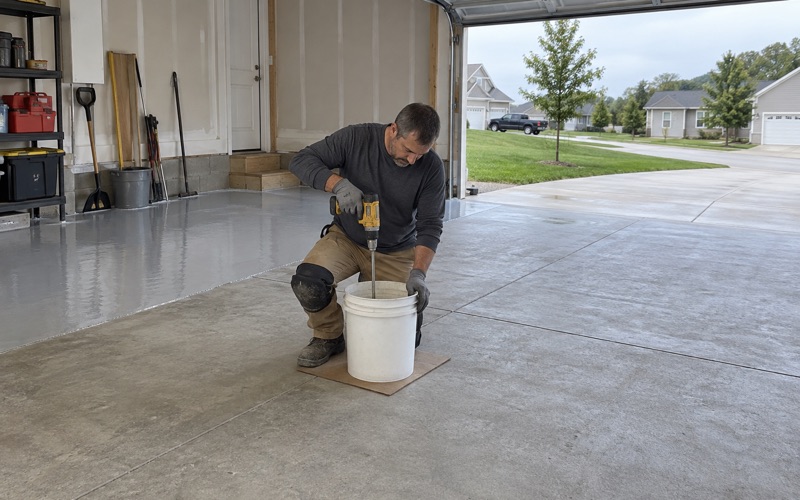
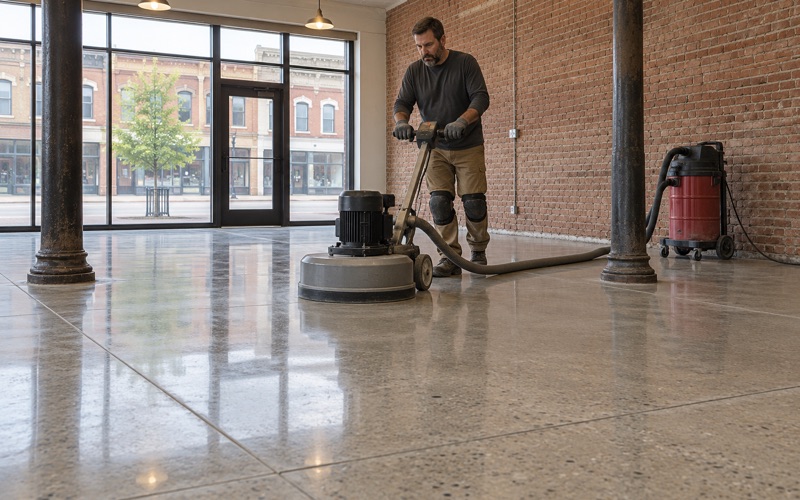
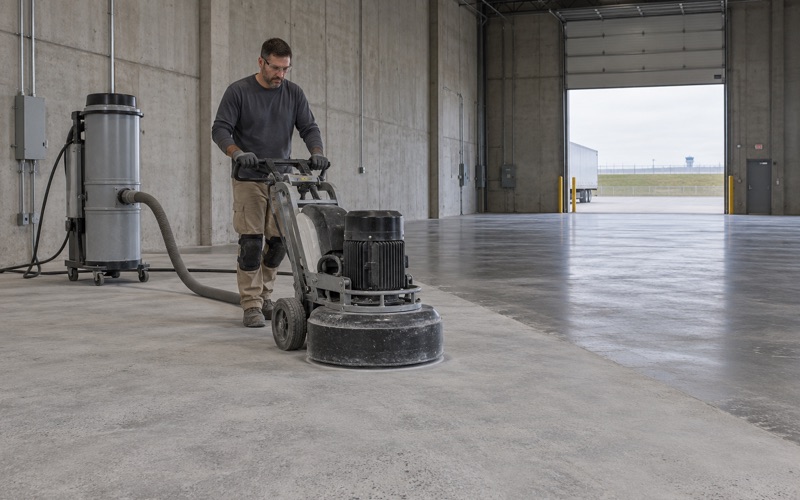
Whatever the system, the slab is opened with a diamond grinder or a shot blaster to the concrete surface profile the product calls for on the ICRI CSP scale. We never acid etch. A screed and a thin epoxy both depend on a clean, sound, profiled surface, and the grinding dust is captured at the machine by vacuum rather than washed toward a floor drain or a storm inlet.
Kitchen, Garage and Basement Floors Across North Liberty
Food-service floors and the county inspector
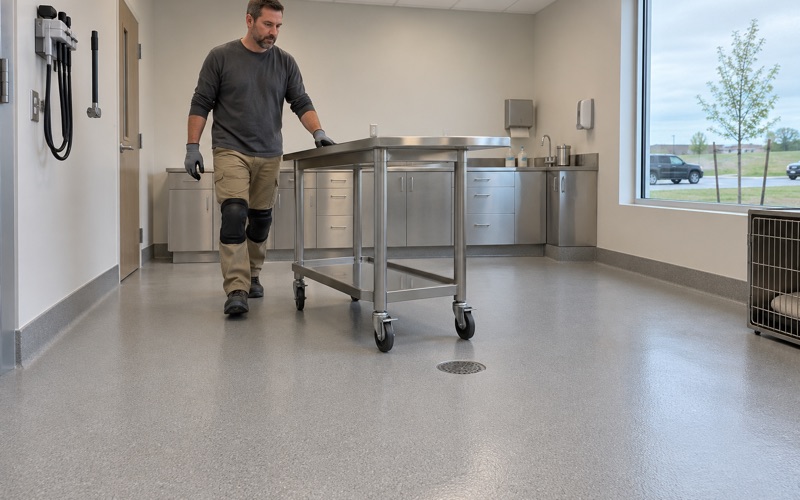
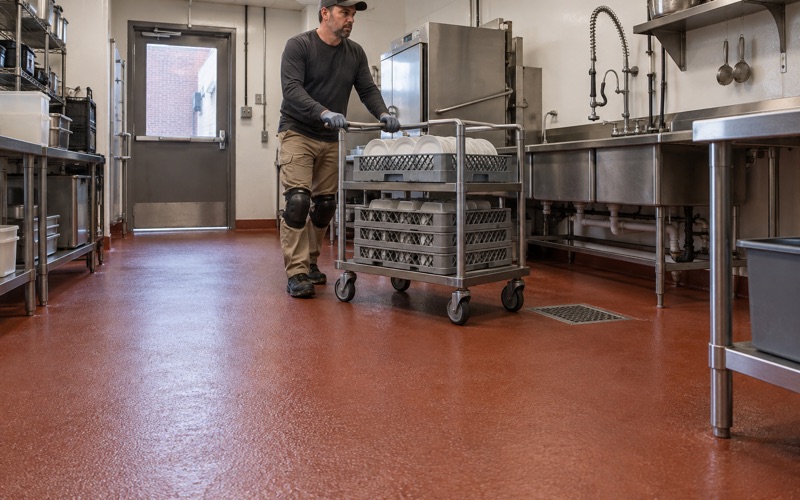
Restaurant, grocery and school kitchens in North Liberty answer to Johnson County Public Health, which licenses and inspects food establishments against the 2017 FDA Food Code with Supplement. We plan those floors around the code: coved floor and wall junctures under FDA Food Code 6-201.13, a broadcast texture specified for wet areas, and a system picked for the hot water and degreasers the kitchen actually uses. Slip resistance comes from the broadcast and the topcoat we write into the scope, not from a promise.
Kitchen and shop work is phased around service. We schedule overnight and weekend windows when a line cannot stop, and cure times follow slab temperature and the dew point spread at the surface rather than a date on the calendar.
A young housing stock with its own questions
North Liberty was the second fastest-growing city in Iowa from 2000 to 2010, and its housing shows it: 64.1 percent of units were built in 2000 or later, and only 13.3 percent before 1980. Detached houses make up 48.9 percent of units and attached single-family homes 22.7 percent, so a lot of garages here share a wall with living space.
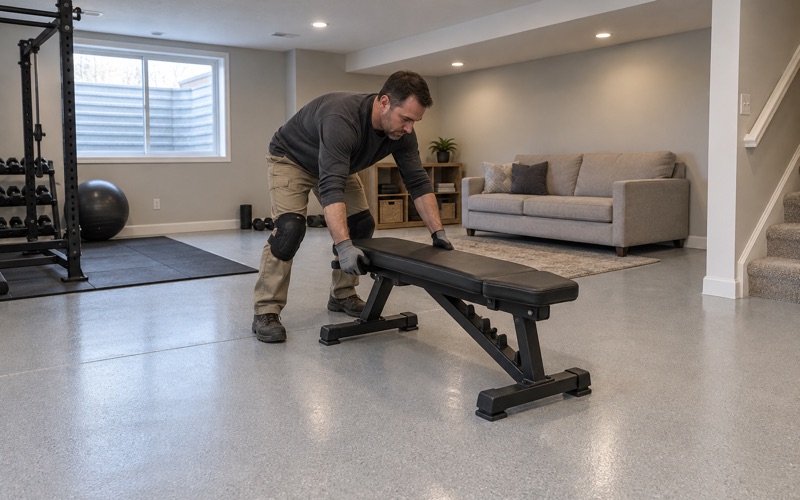
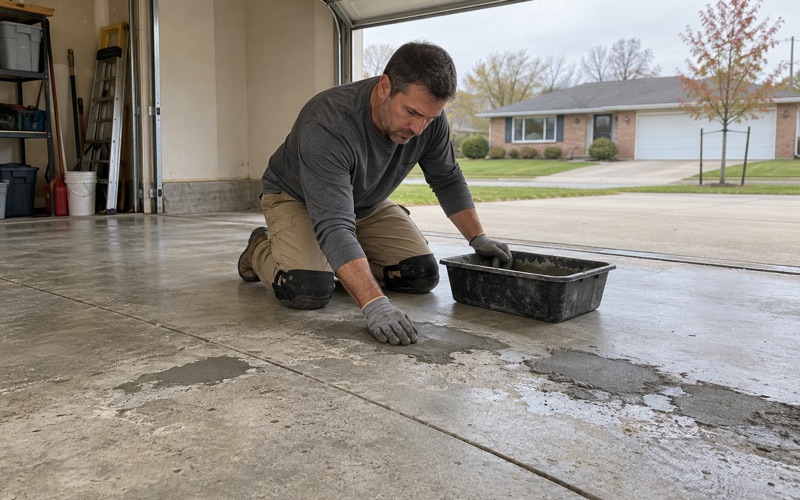
Newer slabs usually carry fewer years of oil stains and patching, but young concrete is not automatically dry. Several soils mapped around central North Liberty, including Colo-Ely and Maxfield, are poorly drained with a seasonal water table at or near the surface. We test with ASTM F2170 in-situ relative humidity probes or ASTM F1869 calcium chloride testing before pricing a basement or garage, and we read basement floors for past water at the sump pit and floor drain first.
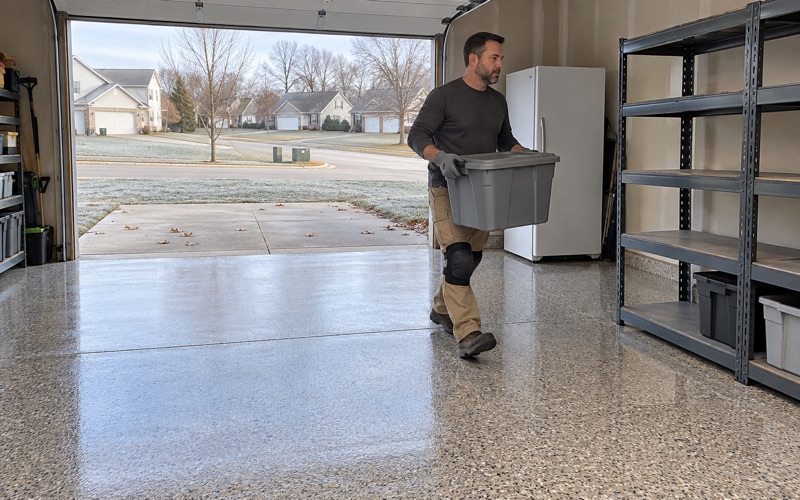
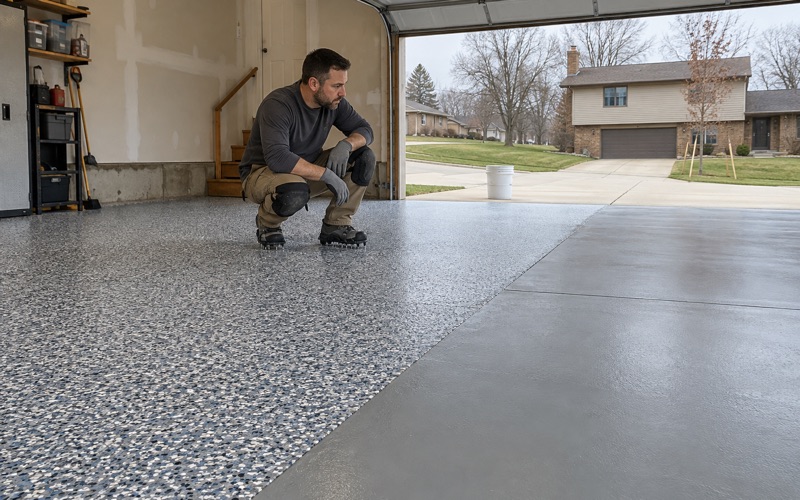
For attached garages and basements, we offer low-odor products as a comfort and re-entry choice. Iowa has no state VOC content rule for floor coatings; the federal limit under 40 CFR 59 Subpart D binds the manufacturers. Garage systems are chosen to stand up to the brine and rock salt that ride in on tires from November through March, and to resist hot tire pickup once the weather warms.
What a coating will not do
A floor coating does not stop water from moving up through a slab, and it is not radon work. Every Iowa county is radon Zone 1, and new one- and two-family homes need passive radon-resistant construction statewide, which is a separate trade with its own credentialing under Iowa Code chapter 136B. We put that in writing on every North Liberty quote, alongside the product, the coat count and the thickness you are paying for.
- 20+ Years on Concrete
- Moisture Tested Before Pricing
- Free Written Estimates