
Marion Epoxy Flooring grinds and polishes concrete floors for businesses and homeowners in Marion, IA, serving surrounding cities including Hiawatha, Cedar Rapids, Mount Vernon, Stone City and Anamosa. With 20+ years of concrete floor work behind us, we treat polishing as a sequence of measured steps rather than a quick buff, and we agree the aggregate exposure and final sheen with you before the first pass.
Polished concrete is not a coating. It is the slab itself, ground with progressively finer diamond tooling, hardened with a lithium silicate densifier and refined until the surface reflects light. Because there is no film on top, there is nothing to peel, chip or wear through, which is why the finish shows up in warehouses, retail stores, offices and, increasingly, in basements and new homes.
The tradeoff is that a polished floor shows the concrete you have. Cracks, patches and stains are part of the picture, so the most useful thing we do on any polishing job is read the slab honestly at the estimate and tell you what the finished floor will look like.
How We Polish a Concrete Floor
Reading the Slab First
Before we price a polished floor, we look at how hard the concrete is, how it was finished, what coatings or adhesives sit on it and where it has been patched. Each of those changes how much grinding the floor needs and what the surface will look like once the paste is cut back.
On a slab that raises questions, we grind a small test area. Seeing the real color and aggregate on your own floor is better than choosing from a photo of somebody else’s concrete.
Grinding in Stages
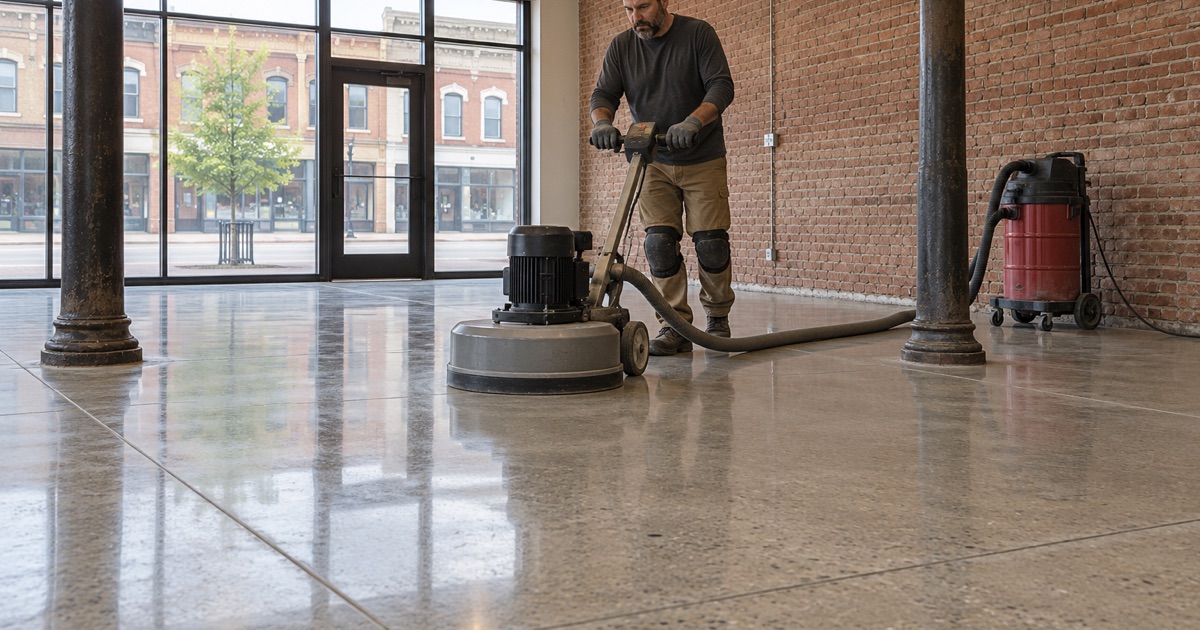
Polishing starts with coarse metal-bond diamonds that remove coatings, glue and the weak surface skin, then steps through finer grits that erase the scratches the previous pass left. Skipping a step leaves swirl marks that show up later under store lighting or low winter sun.
Every grinder runs with a vacuum attached, so the dust is captured at the machine rather than spread through the building or washed toward a drain. In an occupied building that is often the difference between a polishing job the staff barely notices and one that coats every shelf.
Densifying and Refining
Part way through the grit sequence we apply a lithium silicate densifier, which reacts with the concrete to harden the surface and reduce dusting. A harder surface takes a better polish and resists the wear of foot traffic and pallet jacks.
Resin-bond diamonds then refine the surface to the chosen sheen. Where a floor will see spills, we finish with a penetrating guard that helps resist staining without forming a film that could peel.
Joint Filling and Crack Repair
Control joints and cracks are cleaned out and filled before the final passes, using a semi-rigid filler where forklift or cart wheels cross them and a color-matched filler where appearance matters more. Filled joints stop wheel impact from chipping the edges, which is where most warehouse slabs start breaking down.
The filler is ground flush with the floor during the finer grits, so it polishes along with the concrete rather than sitting proud of the surface. Cracks still read as lines in the finished floor, but they no longer collect dirt or catch a wheel.
Choosing the Look
Aggregate Exposure Levels
How deep we grind decides what you see. A light cut leaves mostly the cream of the cement paste, a moderate cut shows a salt-and-pepper scatter of fine aggregate, and a deeper cut exposes larger stones across the floor.
The deeper the cut, the more the slab’s own mix and finishing show through, including any spots where the original finisher left the surface uneven. That is why we decide exposure together, ideally after a test pass.
Sheen and Reflectivity
Polished floors range from a low satin to a high gloss that mirrors overhead lighting. A higher sheen brightens a warehouse or showroom, while a lower one reads calmer in an office or a home and hides minor wear.
Sheen also affects how dirt and scuffs show. Busy entry areas often look better over time at a moderate polish level than at a mirror finish that shows every footprint.
Dyes, Stains and Saw-Cut Patterns
Concrete dyes can tint a polished floor in shades from warm tan to charcoal, and they soak into the surface rather than sitting on it. Saw-cut lines can divide a large floor into tiles, borders or branded zones.
We lay out any cut pattern against walls, doorways and existing control joints before cutting, so the design looks intentional rather than fighting the slab’s own joints.
Commercial Polished Concrete Floors
Warehouses and Distribution Floors
Warehouse slabs are often the best candidates for polishing: large, hard and already finished flat. A polished, densified floor cuts the dust that unsealed concrete sheds under forklift traffic and makes the floor easier to sweep and scrub.
We plan big floors in phases so racking and aisles can stay in use, and we repair damaged joint edges before polishing so wheels are not banging over broken concrete every shift.
Retail, Showroom and Office Floors
In stores, showrooms and offices, polished concrete gives a clean, modern look that stands up to constant foot traffic. Older storefronts often hide a slab under layers of tile and carpet glue, and we grind those back to see what the concrete can offer.
When a slab under old flooring is too patched to polish well, we say so and suggest a coating system instead, rather than polishing a floor that will look blotchy under display lighting.
Working Around Business Hours
Commercial polishing can be done overnight, on weekends or in sections, because there is no coating cure to wait out. Once a section is polished it can go straight back into service.
That makes polishing practical in buildings that cannot shut down, from retail floors to shops and clinics in Marion and around Linn County.
Residential Polished Concrete Floors
Basements and Lower Levels
A polished basement floor is durable and easy to clean, and with area rugs it can look finished without adding carpet that holds dampness. The slab has to be tested for moisture first, because a polished floor does not stop vapor, and some basements need that conversation before any finish goes down.
Where a basement shows signs of past water, efflorescence or a busy sump pit, we read those first. Polishing will not fix a wet basement, and we will not pitch it as a way to.
New Homes and Main Floors
In new construction, polished concrete is most successful when the slab is planned for it before the pour, with a good finish and protection during the build. On an existing house, the result depends on what the slab has been through.
We can usually tell from a short visit whether an existing main-floor slab will polish into a finish you will like, or whether a coating would serve the room better.
Garages and Home Workshops
Some homeowners ask for a polished garage floor because it never peels. It is a fair choice in a heated workshop, but a bare polished slab still absorbs the salty meltwater that drips off cars all winter, and repeated freeze-thaw cycles can scale it.
For a garage that takes daily vehicle traffic through an Iowa winter, we usually recommend a coating system instead and explain why. In a dry shop or hobby space, a densified, guarded polish is easy to sweep, bright under shop lights and very durable underfoot.
- 20+ Years on Concrete
- Moisture Tested Before Pricing
- Free Written Estimates