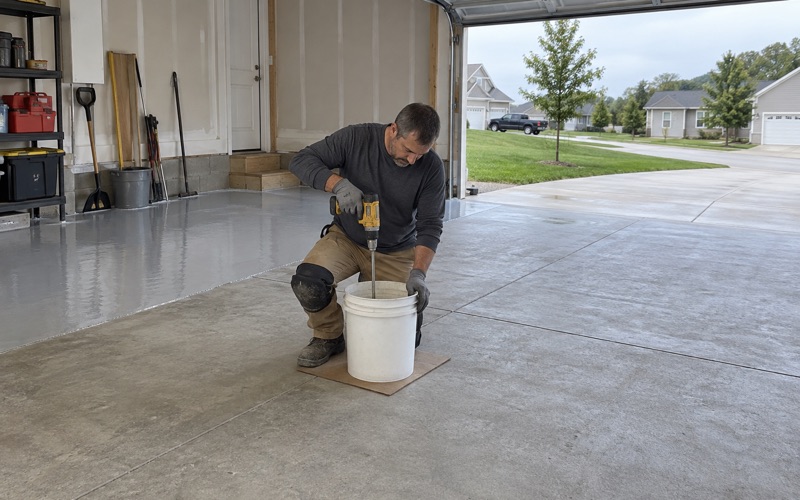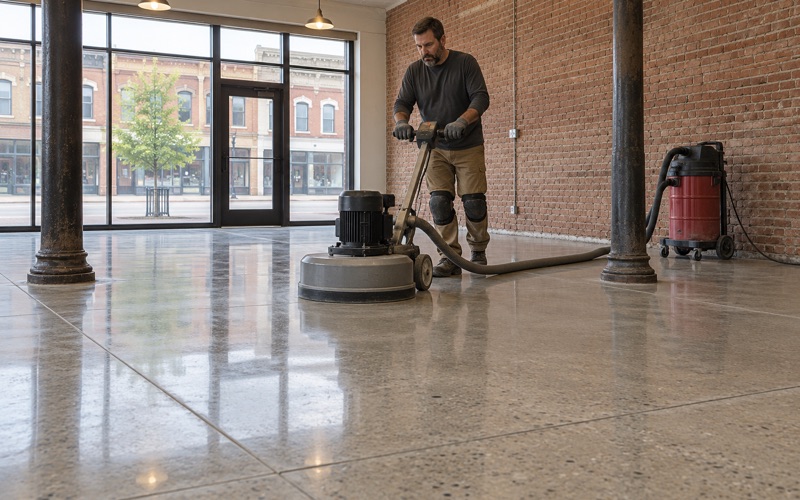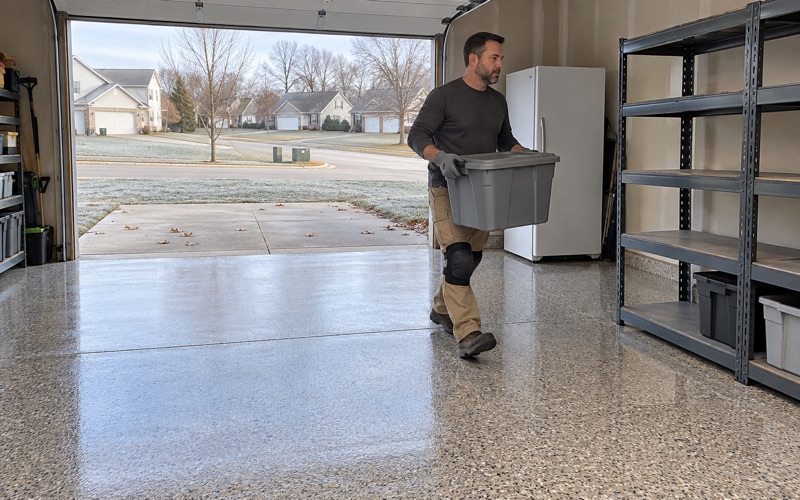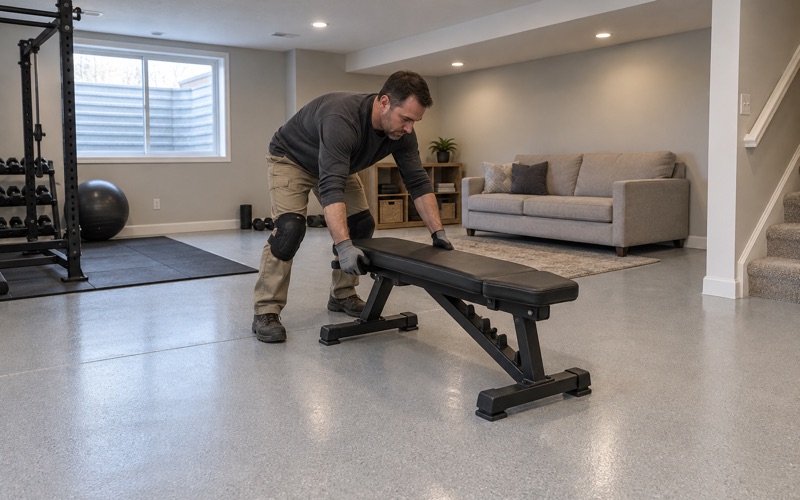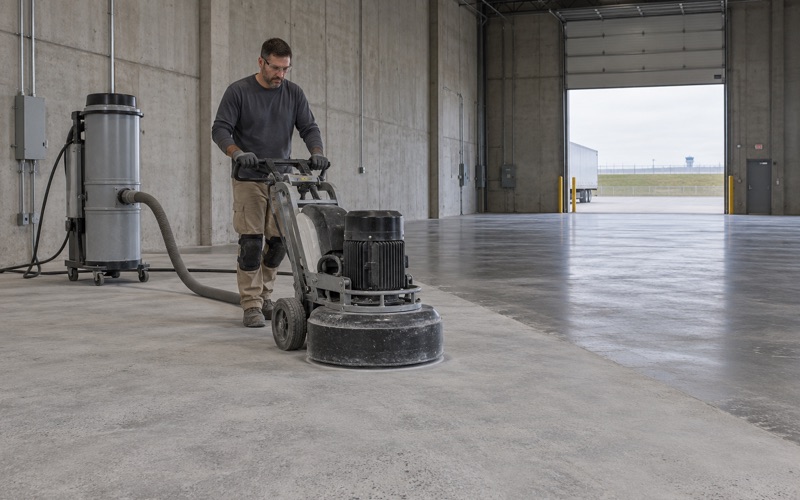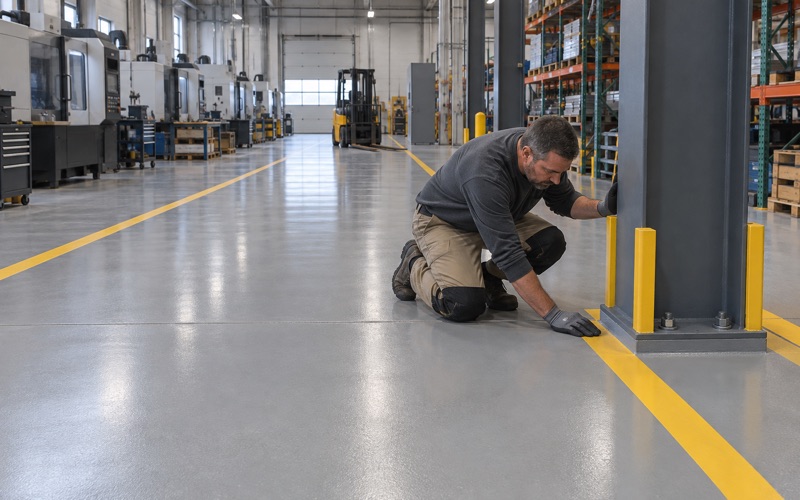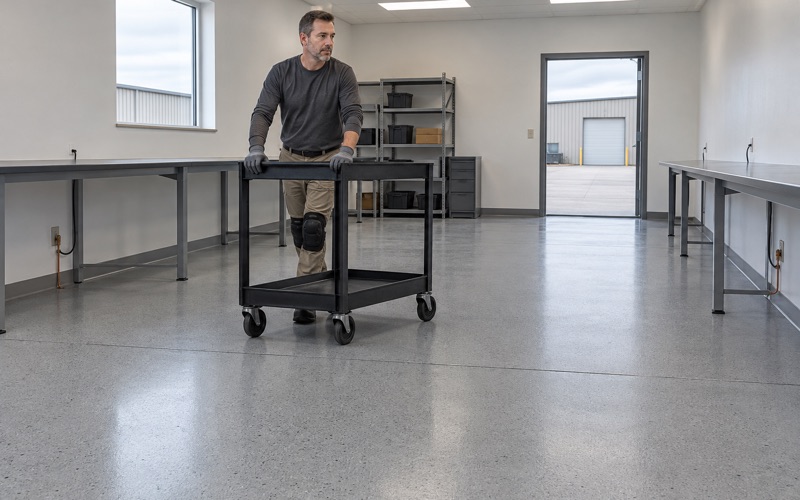
Marion Epoxy Flooring has spent more than 20 years on epoxy-flooring in Stone City and across the Marion, Iowa service area, and the floors we are asked about here fall into two groups: working shop floors that get wet every shift, and the garages and basements of the homes around them. Both start the same way. The slab is opened with a diamond grinder or a shot blaster, never an acid etch, so the coating grips a real profile instead of a weak surface skin.
Before a price is final, a moisture test goes into the written scope, and the proposal names the product line, the number of coats and the finished thickness. That gives you something concrete to check the finished floor against. We also map cracks, spalls and any old coating first, and when a slab needs repair or replacement before it should be coated, we tell you rather than coat over the problem.
Every quote we write says Marion, Iowa, because a search for Marion alone turns up Illinois, Ohio and Florida. What follows covers what is particular about coating floors here, starting with the employer that gives the place its name.
A Quarry Village With a Working Stone Company
Stone City is an unincorporated community and census-designated place in Jones County. It began as a company town for the people who worked the local quarries, and it still has no city government of its own. It sits in Fairview township, and county matters run through Jones County, with Anamosa as the county seat.
The stone is the reason the village exists. Anamosa Limestone has been quarried at the Stone City site since the 1840s, and Weber Stone Company, established in 1952, works it today. A 2009 Geological Society of Iowa guidebook called the operation the largest dimension stone quarry in Iowa.
What comes out of the quarry
Weber Stone Company lists its address as 12791 Stone City Road X28 with an Anamosa mailing address, and the Census geocoder places that address inside the Stone City CDP. The company sells crushed aggregate such as road rock, sand and riprap, along with cut wall stone, veneer, steps, patio squares, fireplaces and countertops. Its stone is machine sawed, and that is the detail that matters for a floor.
Why sawing changes the floor conversation
Sawing dimension stone is typically a wet process. Water cools the blade and holds down dust, and what lands on the floor is a mix of water and fine stone slurry. A floor in that kind of room is a working surface with a housekeeping job to do, and we scope it that way rather than as a showroom finish.
To be plain about it, Marion Epoxy Flooring has no relationship with Weber Stone Company and has never done work for it. We describe the operation because it is what makes industrial floors in Stone City different, not because we have coated any of them.
Looking for epoxy-flooring closer to Anamosa? See Epoxy-Flooring Services in Anamosa.
Mine Property, Mine Rules: Where MSHA Ends and OSHA Begins
Most commercial floors we coat answer to OSHA when it comes to workplace safety. Stone sawing can be different. Under the MSHA-OSHA interagency agreement of March 29, 1979, section 2.6.a, the Mine Safety and Health Administration’s authority includes stone cutting and stone sawing operations on mine property, where those operations do not take place in a stone polishing or finishing plant. A polishing or finishing plant falls to OSHA.
The same agreement, in section 2.5, cites the intention of Congress that doubts be resolved in favor of including a facility under the Mine Act. A saw shop on quarry ground should not be assumed to be an OSHA building just because it looks like a fabrication shop.
What we do not know about any given building
We have not determined which agency governs any particular Weber building, and we have read no mine ID or inspection record. That question belongs to the operator and the agencies. What we can do is ask an owner which framework applies before we write a scope, because it decides which housekeeping language the floor has to serve.
What no agency signs off on
Neither agency hands out approvals for floor coatings, and we hold no mine-safety training credential, certification or contractor ID. So nothing we install is sold with an agency’s endorsement attached. A coating supports an operator’s housekeeping program; it does not stand in for one.
Other rooms, other authorities
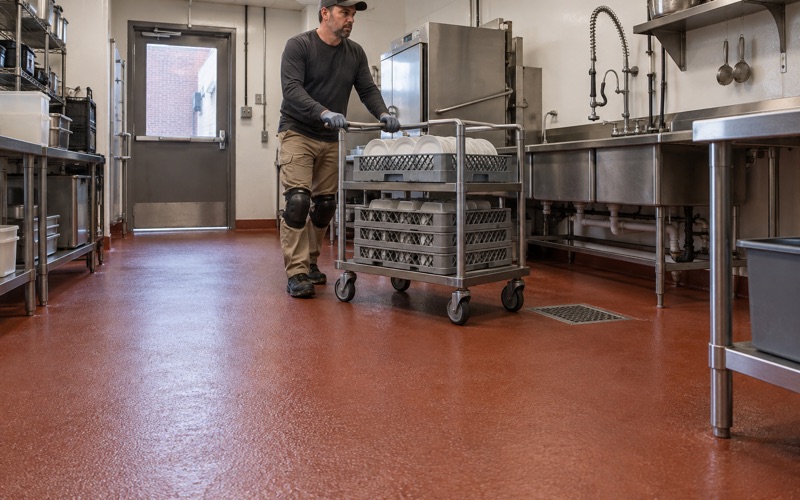
A break room or a food-service floor is a separate matter. Food establishments in Jones County answer to Linn County Public Health, which serves Linn and Jones County under contract with Iowa DIAL. We plan kitchen floors around the FDA Food Code Iowa adopts, with coved bases where floor meets wall and a texture specified for the wet areas.
What 30 CFR 56.20003 Asks of a Floor Under the Saws
Where federal mine law applies to a surface stone operation, the housekeeping standard is 30 CFR 56.20003. Paragraph (a) asks that workplaces, passageways, storerooms and service rooms be kept clean and orderly. Paragraph (b) asks that the floor of every workplace be maintained in a clean and, so far as possible, dry condition, and that where wet processes are used, drainage be maintained and false floors, platforms, mats or other dry standing places be provided where practicable.
Paragraph (c) adds that floors, working places and passageways be kept free of protruding nails, splinters, holes or loose boards, as practicable. A coating cannot make a wet saw room dry. What it can do is make the clean and, so far as possible, dry condition easier to reach, with a sealed, continuous surface that sheds water toward the drainage already in place and gives slurry nothing to soak into.
Shedding water and squeegeeing clean
Bare concrete under a wet saw absorbs water, and stone fines settle into its pores and open cracks. The floor stays damp longer and gets harder to clean each month. A coated floor with the right finish lets a crew push water and slurry off with a squeegee at the end of a shift, and holes and spalls are repaired during prep so the surface stays even. Where the floor meets a wall, a column or a machine base, we carry the coating a short way up so slurry does not settle into the joint.
Grip without a slurry trap
Texture is a balance on a wet floor. Too little and the surface is slick underfoot; too much and slurry packs into the profile and fights the squeegee. We specify slip resistance by the broadcast and topcoat used, such as a quartz aggregate broadcast locked under the topcoat, and we size it for a floor that is wet and cleaned often. Mats and dry standing places stay the operator’s call, and we coat around whatever plan they keep.
Building the system for stone slurry
For a wet process floor we usually look at 100% solids epoxy or urethane cement, depending on how much water the room sees and how long it can be down. Prep is diamond grinding or shot blasting to the ICRI concrete surface profile the product calls for. Grinding dust is captured at the machine with a vacuum rather than washed toward a drain or sump. Shop work is phased around shifts, with overnight and weekend windows when production cannot stop.
A floor that is hosed and squeegeed every shift wears at the topcoat first. We plan for that from the start, so the topcoat can be renewed before traffic reaches the base coat, and the proposal says how and when that recoat is done.
Stone City Homes: Owner-Occupied and Detached
Away from the quarry, the homes we see are detached houses. Census survey data for the Stone City CDP counts every occupied home as an owner-occupied detached house, though the sample is small.
Several quarry-era buildings, including the old stone barn, quarry office, ice house, general store, blacksmith shop and schoolhouse, survive, many of them as homes. The village also carries the memory of the Stone City Art Colony, founded in 1932 by Grant Wood, Edward Rowan and Adrian Dornbush, and St. Joseph’s Catholic Church still stands.
Garage floors
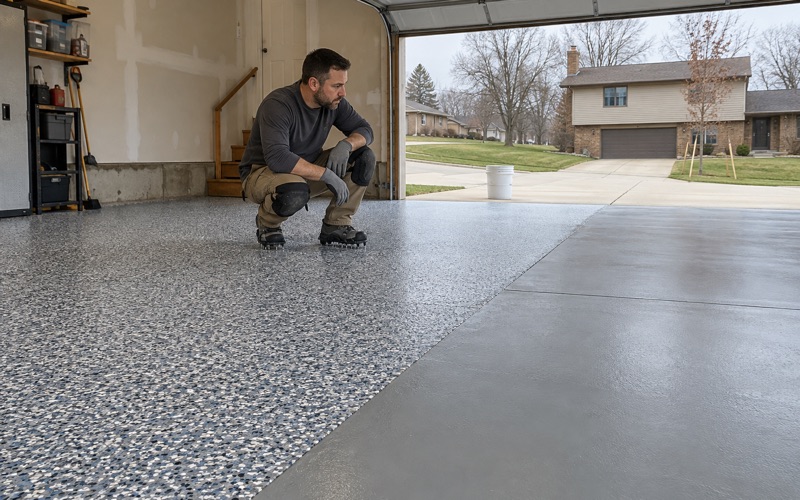
For a garage, we choose a system meant to hold up to the brine and rock salt that ride in on tires from November through March, often a vinyl flake broadcast over an epoxy base with a polyaspartic topcoat. Hot tire pickup is a real failure on thin products, which is one reason the proposal states the finished thickness. Low-odor products are available for an attached garage as a comfort and re-entry choice, not because Iowa law calls for them.
Basement floors
Basements get read for past water before anything else. We check the sump pit and the floor drain, look for efflorescence, and run a moisture test such as ASTM F2170 in-situ relative humidity probes or an ASTM F1869 calcium chloride test as part of the written scope. A coating does not stop seepage, and we put that in writing, along with the fact that a floor coating is not radon work.
What the warranty leaves out
Before a job is sold, we walk through what a coating warranty excludes, and moisture is the first item we name. Exclusions for moisture vapor transmission and hydrostatic pressure are standard, which is why the test comes before the price rather than after the floor fails.
- 20+ Years on Concrete
- Moisture Tested Before Pricing
- Free Written Estimates