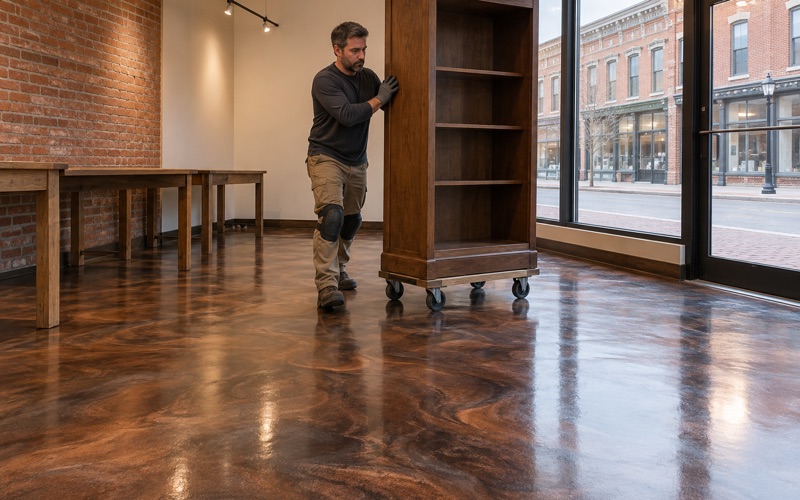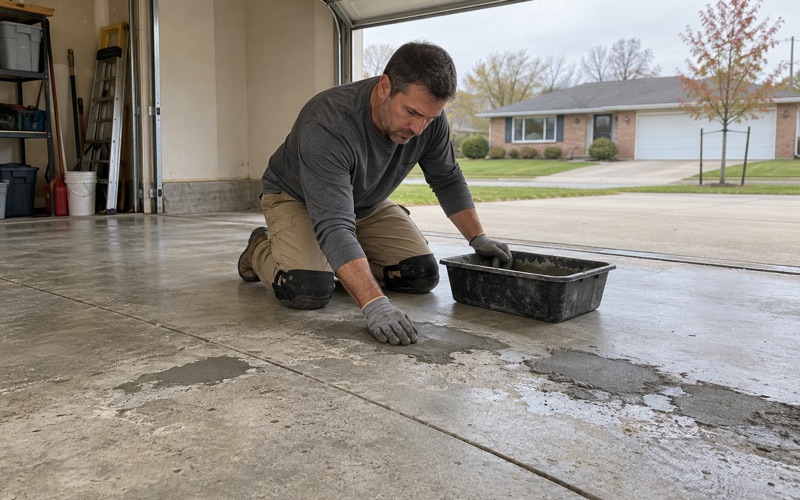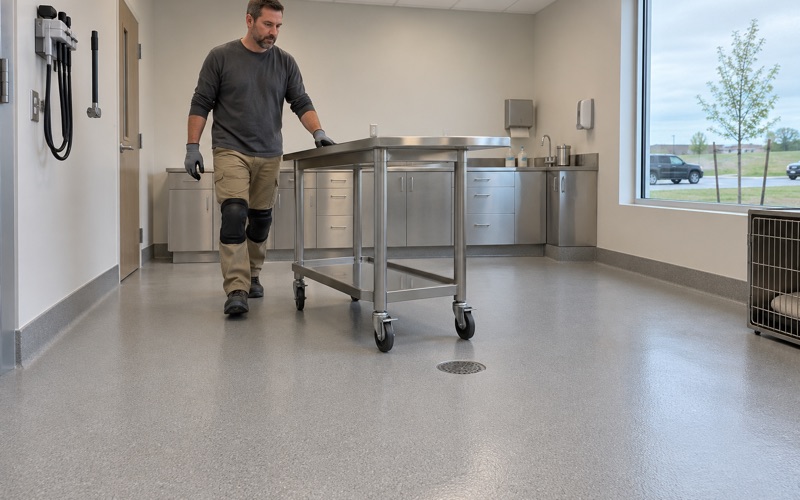
Marion Epoxy Flooring brings more than 20 years of concrete coating work to epoxy-flooring in Vinton, and the first thing we ask about a floor here is not its color or its finish. It is what is already on the slab. A bare garage slab and a basement floor wearing decades of gray porch paint are two different jobs, and in an older house the difference is a matter of state rule, not taste.
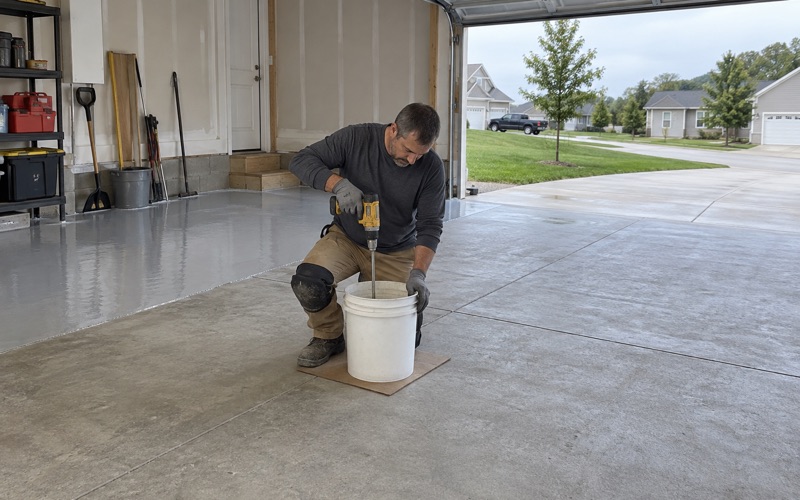
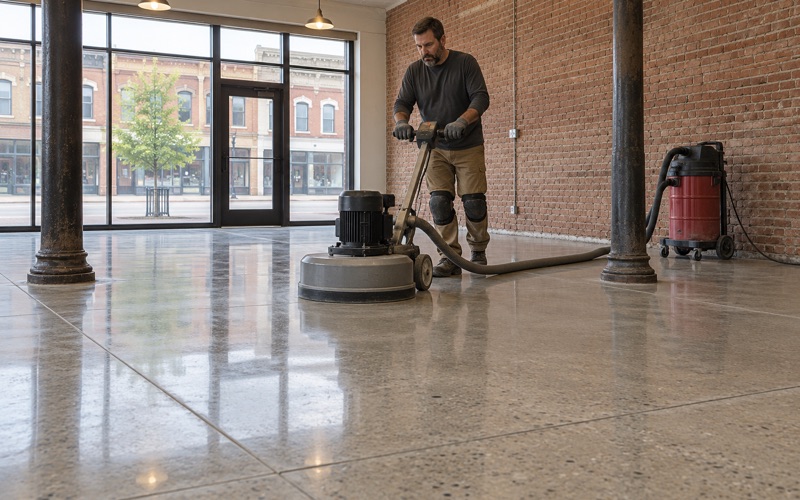
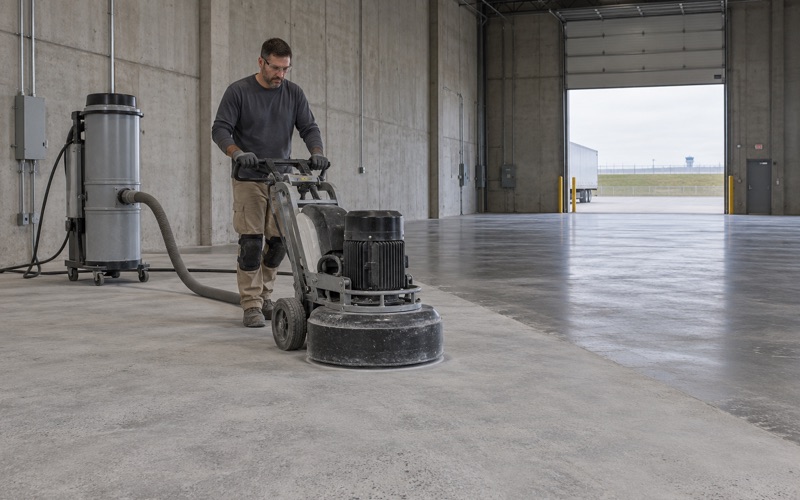
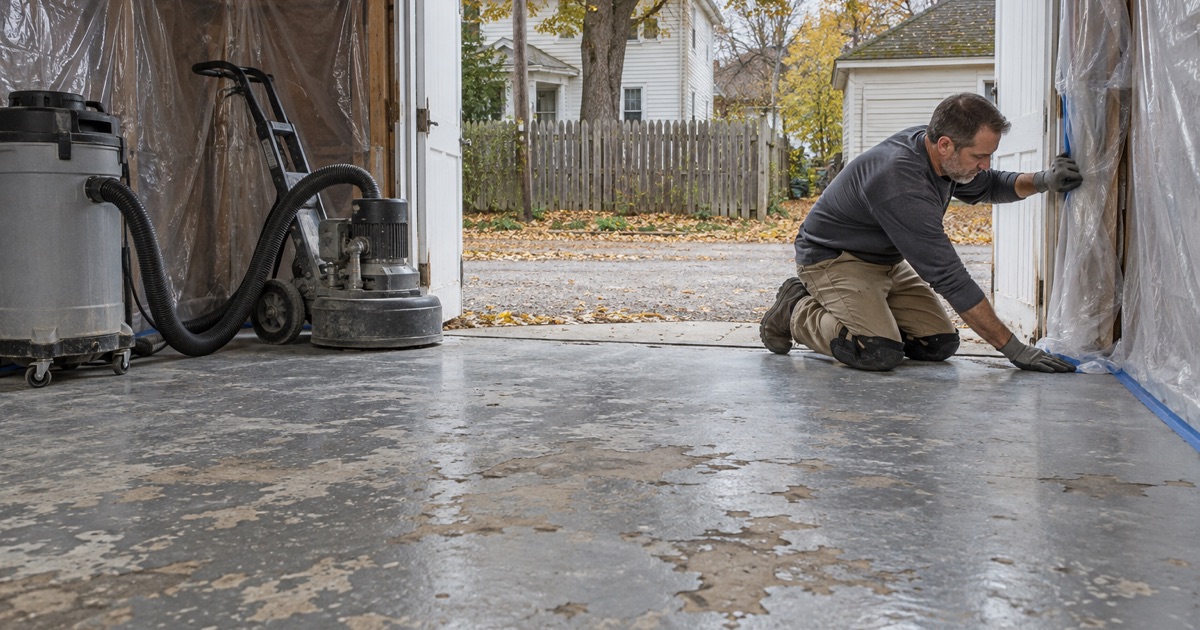
Our prep is mechanical on every floor. We open concrete with a diamond grinder or a shot blaster rather than an acid etch, so the coating bonds to a real surface profile. That is exactly why an old painted floor deserves a careful look first: grinding is the step that turns paint into dust.
So the written scope we hand you starts with what the floor is wearing, then moves to moisture, cracks and the product itself. The proposal names the product line, the number of coats and the finished thickness, and it states plainly which steps belong to us and which belong to someone else.
Vinton’s Historic Houses and the Buildings Behind Them
Vinton is the county seat of Benton County and part of the Cedar Rapids metropolitan area. A good share of its housing is old: by the Census Bureau’s 2020-2024 five-year estimates, 77.5 percent of the city’s housing units were built before 1980, and 1,111 of 2,529 units date from 1939 or earlier. The 1978 line that matters on this page falls inside the 1970s bin, so the exact pre-1978 share is a little lower than that figure.
The Central Vinton Residential Historic District
The clearest picture of that stock is the Central Vinton Residential Historic District, listed on the National Register of Historic Places on November 21, 2012. It covers about 50 acres, roughly between 2nd and D Avenues and West 6th and West 13th Streets. The listing counts 184 contributing buildings, most of them houses and their outbuildings, plus one contributing structure: the brick paving on Second Avenue.
Over 90 percent of the district’s houses are frame construction, the rest brick, and most were built before 1930. Those outbuildings are the detail that matters for a floor contractor. A carriage barn turned garage, a workshop behind the house, a basement under a 1910s frame home: these are the slabs people call us about when they want a coated floor.
Painted floors are the starting point
Many of those floors were painted long ago, then painted again. We have not read any lead finding for a Vinton house or floor, and we would never assume one. The point is narrower than that. Iowa’s rule presumes a painted surface in older housing is lead-based paint until testing says otherwise, and that presumption shapes how the floor can be prepared.
Looking for epoxy-flooring closer to Monticello? See Epoxy-Flooring Services in Monticello.
Where the Asbestos Rule Stops, Iowa’s Lead Rule Starts
Owners of older buildings often know the federal asbestos rule, 40 CFR Part 61 Subpart M. Before renovating a facility, it requires a thorough asbestos inspection. But its definition of a facility excludes residential buildings of four or fewer dwelling units, which describes most of the houses in central Vinton.
That is where Iowa’s lead-based paint rule takes over. It sits at 481 IAC chapter 470, administered by the Iowa Department of Inspections, Appeals, and Licensing, and it applies to renovations in target housing and in child-occupied facilities. Target housing means housing built before 1978, with narrow exceptions for housing for the elderly or persons with disabilities and for housing without a bedroom.
Floors count as building components
The rule’s definition of a building component lists floors, both interior and exterior, alongside walls, doors and stair treads. A painted basement floor is not some gray area outside the rule. It is named in it.
The rule also defines renovation broadly. Any modification of an existing structure that disturbs painted surfaces qualifies, and the definition specifically includes surface preparation activity such as sanding, scraping or other work that may generate paint dust. Preparing a painted slab for a coating fits that description closely.
Detached garages are part of the dwelling
This is the part that surprises people. Under 481 IAC 470.2, a residential dwelling includes a detached single-family home along with its yard, attached structures such as porches and stoops, and detached buildings and structures including garages and farm buildings. The detached garage behind a pre-1978 house is covered the same way the basement is.
There is a small-job carve-out for minor repair and maintenance, such as under 20.0 square feet of exterior painted surface. It applies only where no prohibited practice is used, and machine grinding of paint without the required controls is a prohibited practice. A garage floor is not a touch-up.
Grinding Painted Concrete: HEPA Exhaust, Containment and a Certified Firm
Subrule 470.6(11) sets the work practice standards for renovations in target housing. Among its prohibited practices is machine sanding or grinding of paint unless the machine is used with HEPA exhaust control that removes particles of 0.3 microns or larger at 99.97 percent or greater efficiency. Open-flame burning of paint, uncontained water blasting and dry scraping are prohibited as well.
Who is allowed to do that prep
The same subrule says all such renovations are performed by a certified firm with a lead-safe renovator, certified by the state, assigned to the job (or a certified lead abatement contractor or worker). Interior containment covers the floor with taped-down plastic sheeting or other impermeable material six feet beyond the area being worked.
Marion Epoxy Flooring does not hold that firm certification and does not do lead abatement. We say so in the written scope, not after the fact. On a painted floor in a pre-1978 Vinton house or its outbuildings, we will not grind until the paint question is settled one of two ways.
Two ways the paint question gets settled
The first is testing. Surfaces that a certified inspector or risk assessor determines are free of lead-based paint are exempt from the work practice standards except recordkeeping. Under the rule, lead-based paint means a coating with lead at or above 1.0 milligram per square centimeter or 0.5 percent by weight, so the result is a measured answer rather than a guess.
The second is the regulated path: a certified firm handles the renovation work on the painted surface under the full standards, including containment and HEPA exhaust control on any grinding. Once that work is finished and verified, the slab comes back to us for the coating.
How we fit into that sequence
When we walk a Vinton floor and find paint on it, we write that into the scope as an open item, with our own work priced from the point the slab is either cleared by testing or returned by a certified firm. We do not quote around the question or fold it into a vague prep line. You see where our responsibility begins, and you can schedule the testing or the regulated prep before our crew is booked. On unpainted concrete, none of this changes our normal prep, and we still capture grinding dust at the machine with a vacuum rather than rinsing it toward a floor drain or sump pit.
Cleaning Verification Before the Room Goes Back Into Use
A regulated renovation does not end when the machine stops. The rule calls for cleaning of the work area, with uncarpeted floors mopped using a two-bucket method or a wet mopping system, followed by postrenovation cleaning verification with cleaning cloths and a verification card, or clearance testing.
The floor clearance number
The rule sets the dust-lead hazard on floors at 5 micrograms per square foot, which is the floor clearance level. That number belongs to the certified firm’s verification, not to us, and we start our own work only after that step is documented. Nobody should move a car, a workbench or a family back into the space before then.
Then the coating scope begins
From there the job is an ordinary coating project, and the floor is read like any other. A basement gets checked for past water first, including the sump pit and floor drain, because a coating does not stop seepage. A moisture test, such as ASTM F2170 in-situ relative humidity probes or ASTM F1869 calcium chloride testing, is part of the written scope before the price is final.
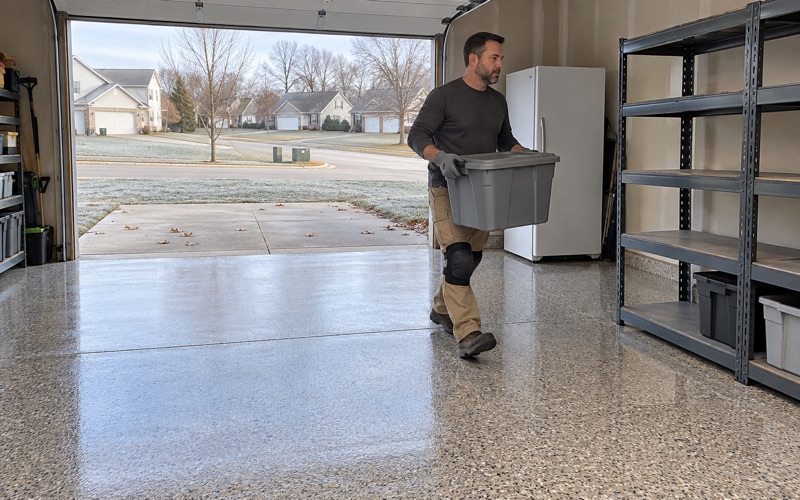
We map cracks, spalls and leftover coatings, and we tell you when a slab needs repair or replacement before it should be coated. The proposal names the system, whether a 100% solids epoxy with a vinyl flake broadcast or a polyaspartic topcoat for a detached garage, along with coats and thickness. We also explain what the warranty leaves out before the job is sold, and moisture vapor transmission is the first exclusion we name.
A garage that sees winter driving gets a system chosen to stand up to the brine and rock salt that ride in on tires from November through March. Texture is specified by the broadcast and topcoat we use, so a slip-resistant floor is something written into the proposal rather than promised as a slogan.
What the finished floor is, and is not
A new epoxy floor over prepared concrete is a wear surface. It is not lead abatement and it is not permanent encapsulation of anything underneath, which is exactly why the paint question gets settled before we arrive rather than covered over. We plan cure times around slab temperature and the dew point spread at the surface, so an unheated outbuilding in winter may be told to wait.
Our office is in Marion, Iowa, and that is the name on every quote. If you own an older house in Vinton and want a coated basement or garage floor, start by telling us what is on the slab now and roughly when the house was built. That answer tells us which conversation comes first.
- 20+ Years on Concrete
- Moisture Tested Before Pricing
- Free Written Estimates